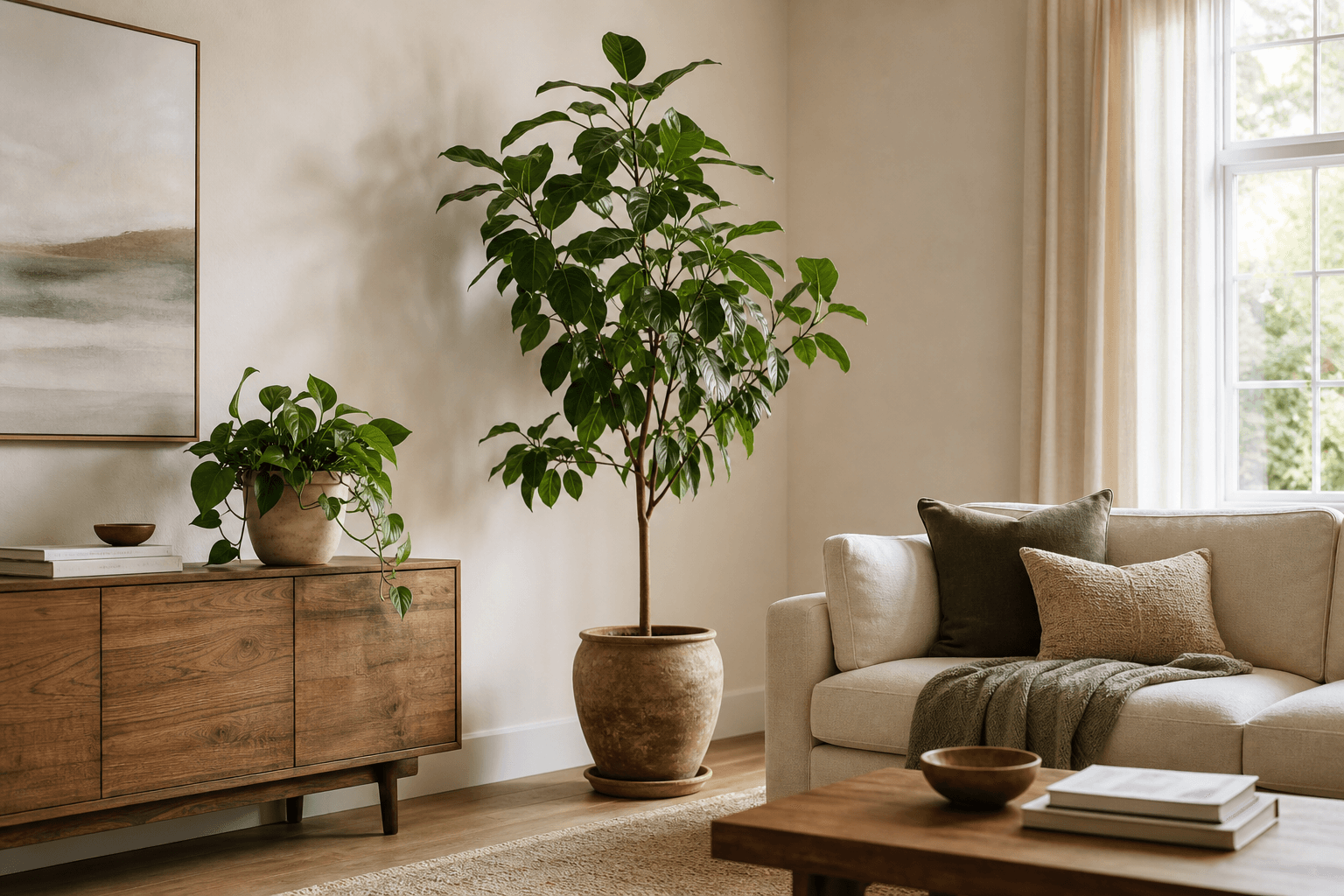
Choose for the room you have
Living rooms often look like they should support almost any houseplant: they may have the largest window, the most open floor and a clear need for softness among the furniture. But they also contain the conditions that complicate plant care. A bright window can become intense in summer. The corner beside a sofa may be much darker than the room appears. Heating, air-conditioning, doors and the ordinary movement of people can create dry or changeable conditions.
That is why the useful question is not simply which plants look good in a living room. It is what the plant needs from this particular living room. Start with the light at the intended position, the space the plant will occupy once it grows, and how easy it will be to water and maintain. Only then decide whether the room needs a tree-like anchor, a compact foliage plant or one trailing line on a shelf.
A plant chosen this way usually looks better too. Healthy foliage has the density, colour and shape that make a room feel considered. A plant placed mainly to fill an empty gap can become sparse, awkwardly stretched or difficult to live around, even if it looked right in the shop.
Map the daylight before choosing a plant
Begin at the exact place where the pot will stand. Look at the window direction, the size of the opening and what is outside it. A clear window facing the brighter part of the sky gives a very different result from one screened by a balcony, neighbouring building, mature trees or heavy curtains. The same room can offer several distinct light zones: bright near the glass, gentler beside it, and much dimmer behind the seating area.
Observe the proposed spot over a normal day. Does direct sun reach it? Is that sun gentle morning light or strong afternoon light? Does the light remain useful once the sun moves? In the northern hemisphere, south-facing windows tend to receive the strongest sun; east and west windows provide more time-limited direct sun, while north-facing windows are generally gentler. The pattern is reversed in the southern hemisphere. These are starting points, not measurements: obstructions and the room’s depth still matter.
Plan for the weaker season as well as a bright summer afternoon. A plant that is comfortable several steps from an open window in summer may need to be moved closer in winter. If the living room has very little natural light at the intended position, the honest choices are a plant that genuinely tolerates that condition, a different position, or a grow light used as a growing tool rather than ordinary ambient lighting.
Give each plant one visual job
A living room is easier to style when every plant has a clear role. A substantial floor plant can anchor an empty corner or balance a long low sofa. A compact plant can give a sideboard a single focal point. A trailing plant can soften a shelf when there is open space for its stems. Once the role is clear, the plant’s size and form become easier to assess.
Avoid asking one plant to do everything. A broad tree-like plant may be perfect beside a bright window but too heavy for a narrow passage. A small plant may make sense on a coffee table but not if it interferes with conversation or needs to be moved every time the table is used. A shelf plant should add a contained shape, not create a barrier to books, light or cleaning.
This also prevents a common problem: adding plants wherever a surface happens to be empty. A room with one clear plant zone and a few visible empty surfaces often feels more generous than a room with a small pot on every table, sill and shelf. The empty space helps the foliage read as a decision rather than a collection.
Match the plant form to the available space
A plant’s nursery size is not its final footprint. Before buying, imagine the pot, the likely leaf spread and the room needed to reach the pot for watering. Tall upright forms can work in relatively compact floor positions because they create vertical interest without spreading widely. Broad-leaved or branching plants need more horizontal clearance. Trailing plants need open wall or shelf space beyond the pot itself.
Measure the working space, not only the empty patch of floor. Leave a path around the plant, room to open curtains or drawers, and enough clearance that people are not brushing leaves every time they pass. A plant placed tightly between a sofa and a wall soon becomes an obstacle, no matter how well its pot fits the initial gap.
Visual weight matters alongside dimensions. A dark, broad-leaved plant in a heavy ceramic pot can feel more substantial than a taller plant with fine foliage. Use that effect deliberately. In a room already full of books, art and patterned textiles, one clean silhouette may bring more calm than several visually complicated plants. In a quiet neutral room, a textured or softly branching form may provide the contrast it needs.
Choose a realistic plant type for the light band
For a bright position near a window, there are many possibilities, but direct sun and heat still need to be considered. Rubber plants and many philodendrons can make strong statement forms when their light requirements are met. A bird of paradise has a bold, architectural presence but needs significant light and room. A plant selected for this zone should be given the position that supports its growth rather than being pushed into the room’s darkest decorative corner.
For gentler but still naturally daylit positions, consider plants chosen for form rather than flowers: a parlor palm can create a softer vertical silhouette, while a cast-iron plant offers lower, durable-looking foliage. Snake plants and ZZ plants are frequently used in less bright rooms, but they are not plants for no-light positions. Their tolerance should not be used to justify placing them far from all daylight indefinitely.
For a shelf or sideboard close to a suitable window, choose a compact form that leaves the surface useful. A trailing pothos or heartleaf philodendron can work when its stems have a clear route and its pot remains easy to water. A small upright plant may be the better answer where the shelf is already lined with books or framed art. Check the plant’s current care guidance before purchase, especially for variegated cultivars, which may need brighter conditions than green forms.
Plan around heat, airflow and daily life
Living rooms are lived in. A plant beside a radiator can dry quickly; one in the path of an air-conditioning vent or frequently opened exterior door may experience repeated temperature changes. Strong sun through glass can be harsher than the rest of the room suggests. Keep plants clear of these extremes where possible, and avoid choosing a sensitive plant for a position that has to work only because it is visually convenient.
The location should allow ordinary care. You need to be able to check the potting mix, carry water to the plant or move an inner pot to drain, wipe leaves and inspect for pests. If a large plant must be dragged across the room for every watering, or if a shelf plant sits above electronics, the arrangement is likely to become stressful. Choose a smaller plant, a lighter inner pot or a more accessible location instead.
If pets or young children share the room, check toxicity and placement with an authoritative plant-safety source before buying. Do not rely on a general houseplant list or assume that a plant is safe because it is common. Physical stability matters too: a tall plant in a lightweight pot can be a risk in an active room.
Use planters to support, not complicate, the choice
The planter should help the plant belong in the room without creating a care problem. Keep a draining nursery or growing pot inside a decorative cachepot when the visible container has no drainage, then empty water that collects in the base after watering. For floor plants, choose a container that feels visually grounded and is stable enough for the foliage above it. For shelves, protect the surface and make sure the inner pot can be removed.
A related family of materials is usually enough to connect several plants: warm terracotta, soft neutral ceramic, dark matte finishes or a controlled mix of woven and stone-like textures. Matching every pot exactly is unnecessary. What matters is that the planter does not fight the foliage, furniture and other objects for attention.
A practical way to narrow the choice
Choose the one or two positions with the most suitable natural light.
Decide what visual job the plant needs to perform in each position.
Measure the pot footprint, expected leaf spread and access for watering.
Select plants whose light needs and mature form fit those limits.
Bring home fewer plants than the room could technically hold, then live with the arrangement before adding another.
The best plant is the one that can stay
The best living-room plant is the one that continues to make sense after the first week: it receives enough light, leaves room for the way you use the room, and can be cared for without a complicated workaround. Start with those conditions. The right form and planter will then help the plant look as though it was chosen for the room, rather than simply placed in it.