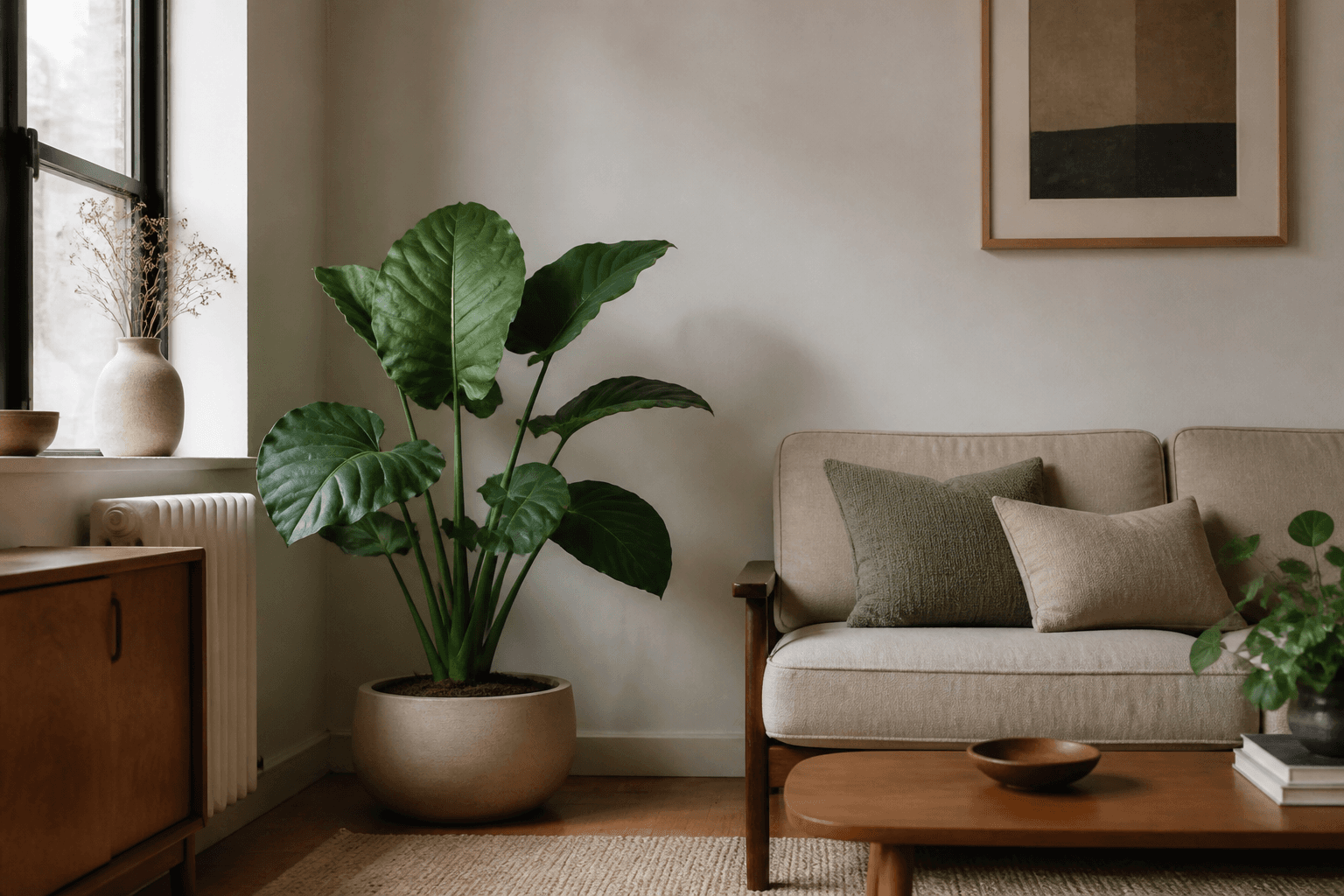
Small rooms can carry one strong shape
A small living room does not need small plants everywhere. In fact, several little pots spread across tables, shelves and sills can create more interruptions than one substantial floor plant. A single clear silhouette gives the eye a place to rest and can balance low furniture without adding another object to every surface. The question is not whether the plant is large; it is whether its size has a useful job in the room.
Start from the usual view of the room. A plant may be useful at the end of a sofa, beside a bright window, or near a low cabinet that needs vertical counterweight. It is less useful in the narrow route between seating and a door, where the leaves become an obstacle. Scale should clarify the layout, not make people navigate around it.
Protect the light and the circulation
The plant’s place must work for it and for the people using the room. Check light at the leaf position, then map the path around the pot. The RHS notes that indoor conditions vary by position, and a location set back from a window can receive very little usable light. Do not put a large light-hungry plant into a dark corner merely because it is the only empty floor area.
Leave enough space to open curtains, sit down, reach a window and water the pot. A plant that is brushed every day will soon be pushed back into worse light or allowed to become dusty and neglected. A narrow upright form may suit a compact room better than a broad-leaved plant with the same height, because the outline leaves more of the floor and wall visible.
Measure the working footprint
Measure the pot base, then add the likely leaf spread, a saucer or cachepot, and the clearance needed to care for it. The nursery plant is not the final size. It can lean toward light, branch, gain leaves and need a larger container. If the room can accommodate it only at today’s dimensions, choose a smaller plant or a naturally contained growth habit.
Visual weight matters too. Dense dark foliage and a heavy ceramic pot can feel larger than their dimensions suggest. In a room already filled with dark furniture, patterned textiles or many small objects, choose a quieter silhouette or a lighter container. In a pale room with low furniture, one broad or upright plant may supply the contrast that is missing.
Give the plant one role
A large plant should anchor one place rather than try to solve every empty area. It can frame the end of a sofa, make a window zone feel intentional, or soften the corner beside a chair. Once it has that role, resist adding several smaller plants nearby simply because the main plant made the area feel successful. The surrounding empty space is part of what gives the large form its presence.
If the room needs more than one plant, separate the roles. Keep the floor plant as the anchor, then use a compact plant on a bright sideboard or a modest trailing plant on a shelf elsewhere. Avoid a second floor plant of similar scale unless the room is genuinely large enough to hold two equal visual masses.
Choose a plant for the actual conditions
Living rooms are often dry in winter because of central heating, and conditions can change sharply near radiators, glazed doors and sunny windows. The RHS recommends matching the plant to the particular light, humidity and temperature of the room. Select a plant that can handle ordinary conditions in that exact position rather than the idealised conditions in a product photograph.
A position close to bright indirect light gives the most freedom. A position farther into the room calls for more restraint: choose a plant that tolerates that level of light, reduce the scale ambition, or use supplemental lighting deliberately. University of Minnesota Extension notes that lower-light plants use water more slowly, so moving a plant back from a window should also change how often you check the soil.
Make the decision before you buy
Before bringing home a large plant, stand a box or chair where the pot would go and live with it for a day. Does it interrupt the route from the door to the sofa? Does it block the best source of daylight? Can you reach the wall, window and pot easily? Is there still enough visible floor around it? This simple test reveals more than a photograph of an empty corner.
Then choose the smallest plant that delivers the visual role you want. A medium plant with a clear silhouette is often a better long-term choice than a very large plant that immediately overwhelms the room. You can allow a suitable plant to grow into the space; it is harder to make an unsuitable one shrink gracefully.
Let the room stay usable
The best large houseplant in a small living room is one that makes the room feel more composed while leaving its light, seating and circulation intact. Give it a genuine growing position, an outline with room to develop and enough breathing space to be seen. Reassess the placement as the plant grows instead of treating the first arrangement as permanent. When those conditions are met, one plant can be generous without becoming too much.