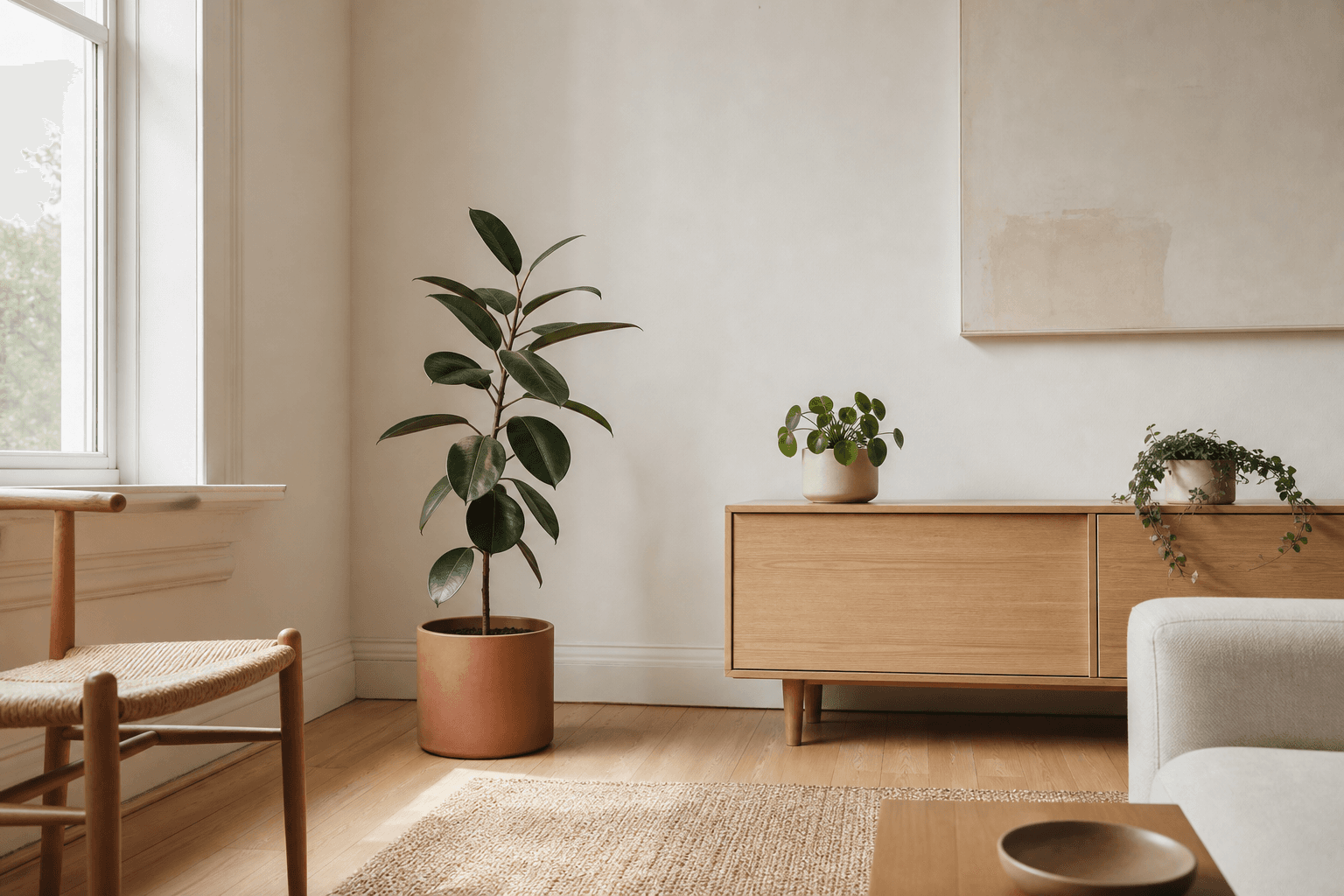
Houseplants can soften a room, fill an awkward corner, or add shape where the furniture feels visually flat. But once every shelf, table, and windowsill has acquired its own small pot, the effect can shift from relaxed to restless.
The solution is not always to own fewer plants. More often, it is to stop treating each plant as a separate decorative object. A room tends to feel calmer when plants are organised into a few clear compositions, with enough empty space around them to make those compositions visible.
Here is how to arrange houseplants so they feel like part of the room rather than a collection that has gradually occupied every available surface.
Start with the room, not the pots
Before moving anything, look at the room without focusing on individual plants. Notice where the furniture already creates visual weight and where the space feels empty.
A large sofa, bookcase, or dark cabinet may already dominate one side of the room. Adding several equally noticeable plant groups nearby can make that area feel heavy. An empty corner, a low sideboard, or the end of a long shelf may need greenery more than the surface that happens to be closest to the window.
Light still sets the boundary. A plant should not be placed in a dark corner simply because the corner needs something. Instead, choose from the parts of the room where plants can realistically live, then decide which of those areas would benefit from a stronger composition.
Create plant zones instead of scattering single pots
A small pot on every surface creates many separate points for the eye to process. Grouping several plants in one or two places usually feels more intentional.
A plant zone might be:
- one large floor plant beside a chair
- three plants grouped on a sideboard
- a shelf with one upright plant and one trailing plant
- a bright windowsill treated as a single display
This does not mean every plant has to sit in a cluster. A strong plant can stand alone. The idea is to avoid a room full of unrelated single pots that all ask for equal attention.
Start by collecting the smaller plants from around the room and testing them together. You may find that five scattered plants become one convincing arrangement, while several surfaces can be left completely clear.
Give each group an anchor
Every plant arrangement needs a visual starting point. Usually, this is the tallest plant, the plant with the largest leaves, or the darkest and most structurally defined pot.
Place that anchor first. Add smaller plants only when they support it.
For a floor-level group, the anchor might be a rubber plant or dracaena, with a compact plant on a low stand nearby. On a shelf, it could be an upright snake plant balanced by a smaller rounded plant and a restrained trailing vine.
Without an anchor, several similar plants can merge into a loose patch of greenery. With one, the arrangement has a hierarchy: the eye knows where to begin and how to move through it.
Mix heights, but do not build a staircase
Plants displayed at exactly the same height can look flat, especially when the pots are also similar. Variation creates depth, but each plant does not need to occupy a perfectly calculated level.
Try combining:
- one taller, upright plant
- one medium plant with a broader shape
- one lower or trailing plant
Use the furniture before adding more accessories. A floor, side table, shelf, and existing cabinet may already provide enough variation. Plant stands are useful when they solve a height problem, but too many stands can add another layer of legs, platforms, and objects to an already busy room.
The goal is not a decorative staircase. It is a loose relationship between high, middle, and low forms.
Pay attention to visual weight
Two plants of the same physical size may not feel equally large.
A plant with broad, dark leaves carries more visual weight than one with fine, airy foliage. A dense ceramic pot can feel heavier than a simple pale cachepot. A trailing plant may occupy little shelf space but draw a long line down the wall.
Use those differences to balance a group. Pairing three heavy, broad-leaved plants can make a small display feel dense. Adding a lighter, finer texture creates contrast and gives the composition more air.
This is also why a large plant does not always make a room feel more cluttered. One clear silhouette can be calmer than six small pots with different leaves, colors, saucers, and labels.
Repeat something, but not everything
A plant display needs enough repetition to feel connected.
The easiest element to repeat is the planter palette. You might use mostly terracotta, warm neutral ceramics, or black and off-white pots. They do not need to match exactly. A shared material, finish, or color family is usually enough.
Repeating plant shapes can also work. Several upright plants create a cleaner, more architectural arrangement, while a mix of broad, fine, and trailing foliage feels looser and more layered.
Avoid making every feature different at once. If all the pots, leaf shapes, heights, colors, and stands compete, the group can feel less like a composition and more like storage.
A useful rule is to keep one element consistent while varying the others.
Leave visible space around the plants
Negative space is what separates a display from clutter.
A plant does not need another plant beside it simply because there is room for one. Let the outline of a large leaf remain visible against a wall. Leave part of a shelf empty. Keep a little distance between a plant group and the next decorative object.
This matters especially with trailing plants. A vine needs open space around its line to look deliberate. When it crosses picture frames, books, cables, and several other plants, the effect can become messy even if the plant itself is healthy.
Try removing one item from a crowded arrangement before adding anything new. The missing object often improves the composition more than another pot would.
Group plants that can actually live together
A good-looking arrangement is useful only if the plants can remain healthy in that location.
Plants grouped beside the same window do not need identical care routines, but they should tolerate the available light. A sun-loving succulent placed behind a large tropical plant may be shaded even when the overall group sits near a bright window. A moisture-loving fern and a drought-tolerant cactus may also be inconvenient neighbours if the display makes their different watering needs easy to forget.
Check each plant individually rather than assuming the group creates one shared microclimate. Rotate pots when necessary, keep drainage accessible, and make sure taller plants are not blocking most of the light from smaller ones.
The design should support maintenance, not hide it.
Edit plants that no longer fit the room
Sometimes the arrangement is not the problem. A plant may simply have outgrown the space, become visually awkward after pruning, or no longer suit the conditions available.
That does not mean the plant has failed. It may work better in another room, on a larger piece of furniture, or with a friend who has more suitable light and space.
Editing is part of styling a living collection. Plants grow, lean, lose leaves, and change shape. An arrangement that worked last year may need to be rebuilt rather than preserved indefinitely.
A simple way to reset the room
When the whole space feels busy, use this quick process:
- Remove the smallest plants and decorative accessories from the main surfaces.
- Choose one or two areas with suitable light for plant groupings.
- Place the largest or strongest plant in each area.
- Add only the plants that improve the height, shape, or balance of the group.
- Repeat one planter material or color.
- Leave at least one nearby surface or section of shelf mostly empty.
- Live with the arrangement for a day before adding anything back.
A room does not need to look minimal to feel considered. It only needs a clear hierarchy. Some plants can gather together, one can stand alone, and others can move somewhere they have more room to be seen.
The point is not to make plants disappear into the interior. It is to give each plant—or each group—enough purpose and space that it feels as though it belongs there.
---