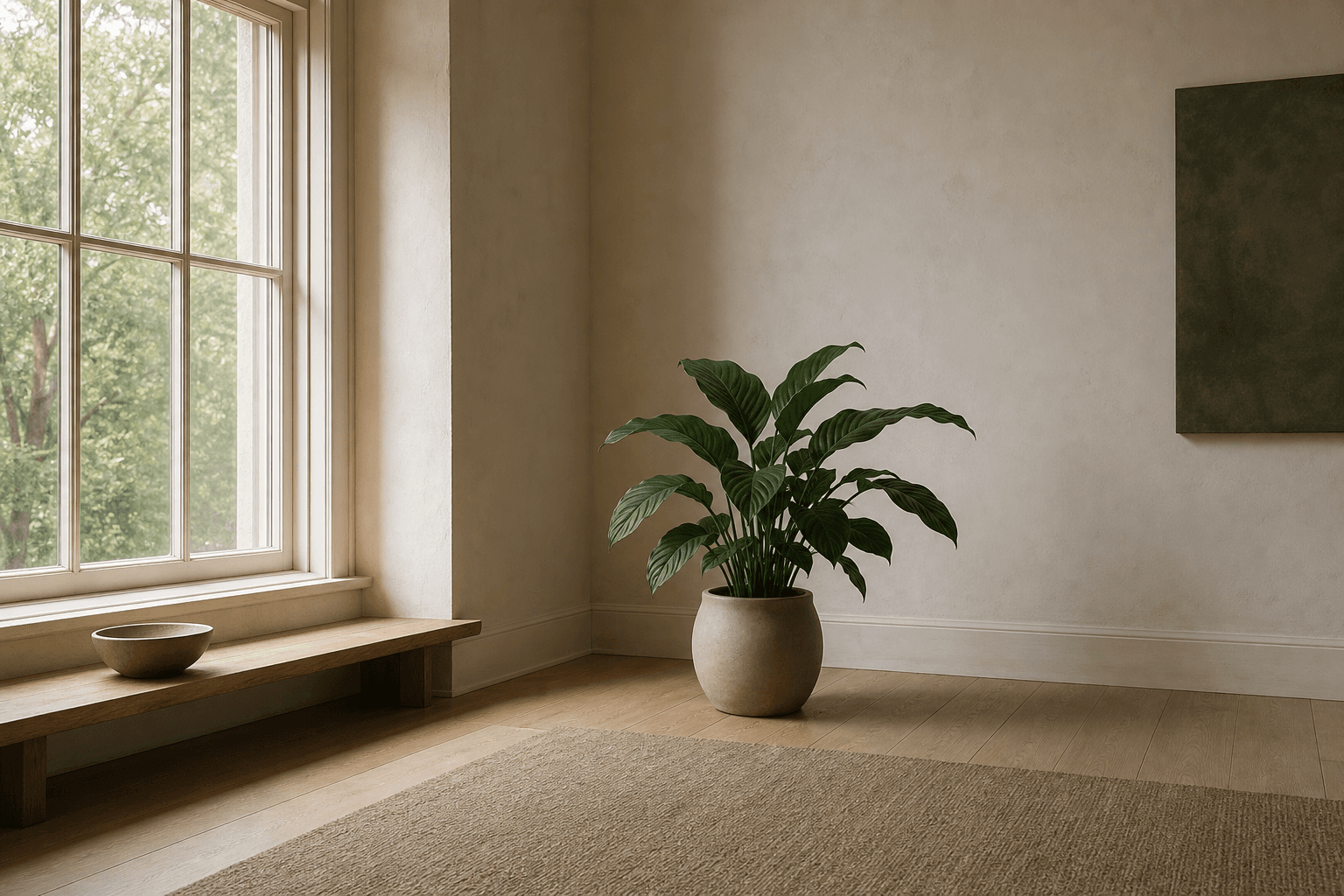
Distance changes the plant’s conditions
A window is a source of daylight, not a guarantee that every part of the room receives the same amount. Light falls away as it travels into the room, and it is reduced further by glass, curtains, neighbouring buildings, balconies, trees and furniture. That is why a plant placed a metre from a large, clear window may be in a far better position than one directly on the sill of a shaded window.
It is tempting to use a rule such as “keep every plant within two metres of a window.” Rules like this are useful only as prompts to look more closely. They cannot account for the size and direction of the window, the depth of the room, or whether a building opposite removes most of the sky. The relevant question is how much useful light reaches the leaves where the plant will actually stand.
Read the window before you measure the room
Begin with direction, but do not stop there. In the northern hemisphere, south-facing windows usually offer the strongest light, while east and west windows give more time-limited direct sun. North-facing windows are often gentler and can be useful for plants that tolerate lower light, although winter daylight may be limited. In the southern hemisphere, reverse the directional pattern. The principle is to observe the actual room rather than apply a label from a chart.
The Royal Horticultural Society notes that indoor light changes across the day and through the year. A spot that is pleasantly bright in summer can become much weaker in winter, while strong summer sun may scorch foliage that is comfortable there in colder months. Sheer curtains, blinds and frosted glass can soften harsh light, but they also reduce intensity. Treat them as part of the position, not as decoration separate from plant care.
Spend one ordinary day watching the proposed location. Notice when direct sun reaches it, whether the sun is filtered, and whether the light remains usable when the sun moves on. Then repeat the observation in another season if the choice is important or the plant has demanding light needs.
Use the depth of the room as a caution
The back half of a deep room is often dramatically dimmer than the area close to the glass, even when the whole room feels light and open. A tall bookcase, a deep sofa or a long dining table can make the distance look visually modest while still placing a plant beyond its comfortable light range. This is especially common in rooms with one main window and in apartments where a balcony above shades the opening.
There is no need to treat every step away from a window as a problem. A robust, lower-light-tolerant plant may work in a slightly recessed location; a plant that needs bright indirect light may need to remain much closer. The mistake is choosing a plant for the room’s general atmosphere and then placing it in the darkest part because that is where the furniture has left an empty space.
If the best visual location is too far from daylight, change the plan rather than forcing the biology. Use a smaller plant near the window, choose a genuinely shade-tolerant option, move a chair or cabinet to open a better plant zone, or add a thoughtfully positioned grow light. A lamp can be a practical solution, but it should be chosen and placed as a growing tool, not assumed to be interchangeable with ordinary room lighting.
Match the distance to the plant’s job
A plant selected as a statement near a bright window has a different job from one softening a shelf farther into the room. A broad-leaved plant that needs good light may be worth giving the prime floor position because its dense foliage and clear silhouette are part of the room’s composition. A smaller, lower-light-tolerant plant may be a better fit for the sideboard that is visually useful but not close to the window.
This is where design and care support each other. Give the stronger-light position to the plant whose form will actually make use of it. Do not hide the most light-hungry plant behind a sofa simply because the pot matches the room. Likewise, do not fill the windowsill with every plant you own; crowding can block light from smaller leaves and make routine care awkward.
When several plants share one window, leave space for each one to receive light. Taller plants should not permanently shade smaller ones, and trailing plants should not turn the glass into a curtain. Rotation can help a plant grow more evenly, but it cannot make a dim position bright enough.
Let the plant give you evidence
The first few weeks after moving a plant are a useful observation period. Look for growth that is compact and proportionate, leaves that keep their expected colour, and a drying pattern that is manageable. A plant that leans strongly toward the window, produces longer gaps between leaves, becomes pale or sheds older foliage may be asking for more light. The RHS lists weak, spindly growth and pale leaves among signs of insufficient light.
Too much light can also be visible. Bleached, scorched or crisp patches—particularly after a sudden move into direct sun—suggest that the plant needs filtering or a little more distance. Move in small increments where possible, and give the plant time to adjust before interpreting every damaged leaf as a continuing problem.
Avoid diagnosing only from one symptom. Leaf loss can follow a move, a watering problem, temperature swings or pests as well as a light mismatch. Check the location, potting mix and recent changes together. The aim is not a perfect measurement; it is a stable placement that supports healthy growth.
A practical test before buying
Use this short process when planning a new plant. First, stand where the pot will sit and look toward the window: is there an open view of daylight or is the position screened by furniture and objects? Second, note the window direction, direct-sun period and any exterior shade. Third, decide whether the plant must be near the glass, beside it, or can live farther into the room. Finally, choose a plant whose stated light needs match that band of light.
A photograph taken from the proposed position can be useful when checking a plant label or a horticultural reference later. It prevents a common mistake: remembering a room as bright because the window itself is impressive, then buying for a spot that is not actually bright. The same process is useful when rearranging existing plants at the beginning of winter.
Place for light, then compose
The most dependable rule is simple: put the plant as close to usable daylight as its needs require, then adjust for harsh direct sun and the room’s layout. Begin with the light, not a fixed number of metres. Once that boundary is clear, use the available positions to create a composition that feels intentional. The plant will look more convincing when its leaves are healthy, and the room will work better when the placement does not ask either the plant or the people living there to compromise constantly.