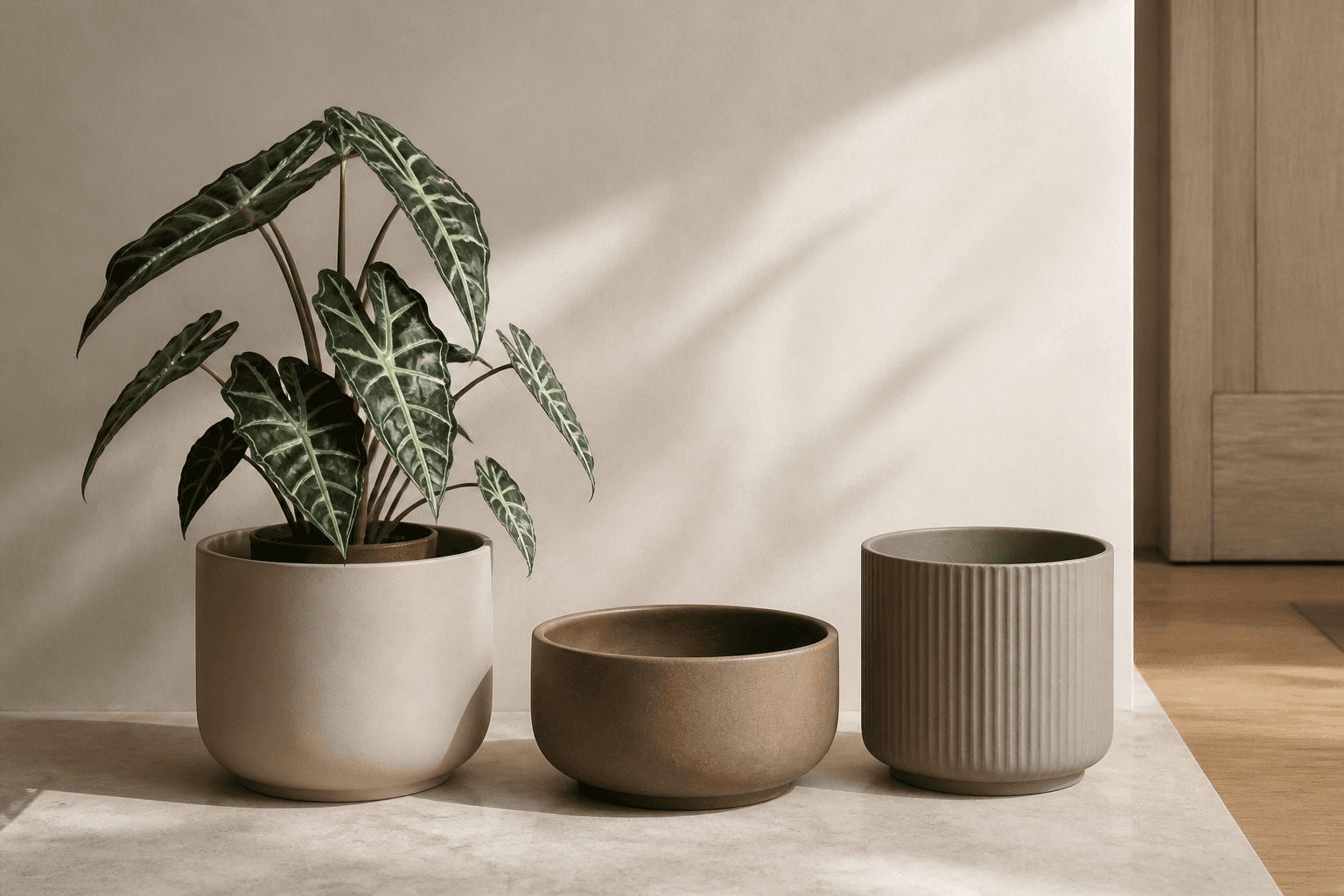
A planter has two jobs
A planter is easy to treat as a finishing accessory, especially when the plant arrives in a thin plastic nursery pot. But it has two separate responsibilities. The growing pot needs to help the roots receive water and air in a predictable way. The visible container needs to make the plant feel settled in the room. Those roles can be performed by one pot, but separating them is often the more practical choice.
Start with the plant rather than the colour of the room. A healthy root system, a way for excess water to leave the pot and enough room to water without damaging furniture are the conditions that let a good-looking arrangement last. Once those conditions are in place, the outer container can do the quieter design work: grounding a tall plant, giving a small plant enough presence on a shelf, or connecting several plants through a restrained material palette.
Decide whether you need a growing pot or a cachepot
A growing pot is the container that holds the potting mix. For most houseplants, it should have drainage holes. This gives excess water a route out of the root zone and makes it easier to water thoroughly instead of adding small, uncertain amounts. A cachepot is an outer decorative container. It can be ceramic, metal, woven fibre or another material chosen primarily for appearance, provided the plant remains inside a draining inner pot.
The cachepot approach is especially useful for plants in nursery pots that are otherwise the right size. Place the inner pot on a small riser, cork pads or another simple support if needed so it is not resting in collected water. When watering, either lift the plant out and let it drain in a sink or bath, or water carefully and check the outer pot afterwards. The right routine depends on the plant’s size and the room, but the standing water should not be ignored.
A single pot with a drainage hole and a saucer is equally valid. It is often the easiest option for a plant that is watered in place, particularly on a floor where a heavy cachepot would make lifting impractical. The saucer must be large enough to catch runoff without overflowing, and it should be checked after watering rather than left full.
Choose size for the roots, then check the silhouette
Pot size is not a styling decision alone. Moving a plant into a container that is much larger than its root ball can leave a large volume of potting mix wet for too long, while a pot that is too small can dry rapidly and make a plant top-heavy. When repotting, use the plant’s root system and a reliable horticultural instruction for that species as the starting point. The decorative outer pot only needs enough room to hold that inner pot comfortably.
Visually, the base should make sense beneath the foliage. A tall floor plant needs a container that feels grounded enough for the height above it. A very broad, dark-leaved plant can carry more visual weight than a finer plant of the same height and may need a simpler, more substantial pot. A small plant on a table usually looks better in a lower container that does not turn it into a tiny object on a pedestal.
Do not judge only from the front. On a shelf or sideboard, depth matters as much as height. A generous pot can push leaves into a wall, make watering awkward or leave too little usable surface around the plant. For a floor plant, include the likely leaf spread and the space needed to lift the nursery pot out. A planter that fits tightly on the day it arrives can become inconvenient as the plant grows.
Use material to support your watering routine
The material of the growing pot affects how quickly the mix dries. Unglazed terracotta is porous and generally allows moisture to leave through the sides as well as the surface. Plastic and glazed ceramic are less porous and tend to retain moisture longer. Neither material is universally superior: terracotta may be helpful for a plant or owner who prefers a faster-drying setup, while plastic can be practical for a plant that should not dry too quickly.
Material also changes weight. A large ceramic pot can help steady a tall plant, but it can be difficult to move for cleaning, seasonal repositioning or a thorough watering. A lighter nursery pot inside a decorative cover offers flexibility. Woven covers can add softness to a room, but use a liner or an inner saucer and check for trapped moisture. Metal containers can work as cachepots, yet should not be assumed to provide insulation or drainage by themselves.
Choose a setup you can actually maintain. If a plant is too heavy to lift, too awkward to inspect or placed where runoff risks a timber surface, the material choice has created a care problem. The best planter is often the one that makes the correct routine easy enough to repeat.
Make the planter relate to the room
Once the plant’s practical needs are covered, use the planter to establish scale and rhythm. It does not need to match the sofa, the curtains and every other pot exactly. A shared family is enough: warm off-white ceramics, a sequence of earthy clay tones, dark matte containers, or a quiet mix of timber and woven fibre. Repetition gives several plants a relationship without making the room look staged.
Let the foliage determine how much visual activity the pot can carry. Strongly patterned leaves, very dark foliage and large glossy leaves often benefit from a simple form and finish. A fine-leaved or visually quiet plant can take a little more texture, provided the container does not overwhelm its scale. If the room already has patterned textiles, art and objects, a planter can offer a useful pause rather than another decorative event.
It is also useful to vary one dimension at a time. Keep the colour family related while changing the shapes, or use one repeated silhouette in several tones. When every pot has a different colour, gloss level, pattern and height, even healthy plants can begin to read as a collection of unrelated objects.
Plan for the surface underneath
Water damage is part of planter choice. Timber, painted furniture, porous stone and some floors can be marked by a damp pot, mineral deposits or a saucer that overflows. Before placing a plant, decide where water will go during routine care. A waterproof liner, saucer, tray or plant stand with a protective base can make the difference between a plant that remains welcome and one that becomes a source of anxiety.
Avoid using a decorative tray as evidence that drainage no longer matters. A tray catches runoff; it does not make prolonged standing water harmless. Empty it after watering once the pot has drained. On a shelf, leave a little room to remove the inner pot, wipe the surface and inspect leaves. A display that is hard to clean often becomes visually cluttered long before the plants are the problem.
Choose deliberately for common locations
For a floor plant, choose a stable base and keep the outer pot proportionate to the mature plant rather than only its current nursery size. Place it where watering access does not require dragging it across the room. For a table plant, keep the pot low enough that the plant remains part of the table rather than blocking conversation or a lamp. For a shelf, prioritise shallow depth, a removable inner pot and a surface protection plan before adding a decorative cover.
A group of plants does not need matching pots, but it does need a hierarchy. Give the largest plant the strongest or simplest base, then let smaller containers support it without multiplying finishes. If a room feels busy, remove one plant or one decorative object before buying a set of new planters. The composition may already be asking for less.
A final check before you buy
Confirm whether this is a growing pot, a cachepot or both.
If it is a growing pot, confirm that it has drainage holes and a safe plan for runoff.
Measure the inner pot, the available depth and the space needed to lift the plant out for watering.
Check that the material and weight suit the way you will actually care for the plant.
Choose the colour and finish last, in relation to the foliage and the room’s existing materials.
The verdict
The right planter solves the practical problem first and the visual one with restraint. Give the plant drainage, appropriate root room and a care routine that is realistic. Then choose a proportion and material that lets the foliage belong in the room without turning the pot into the main subject. When both jobs are clear, even a simple nursery pot inside a well-chosen cachepot can look completely resolved.