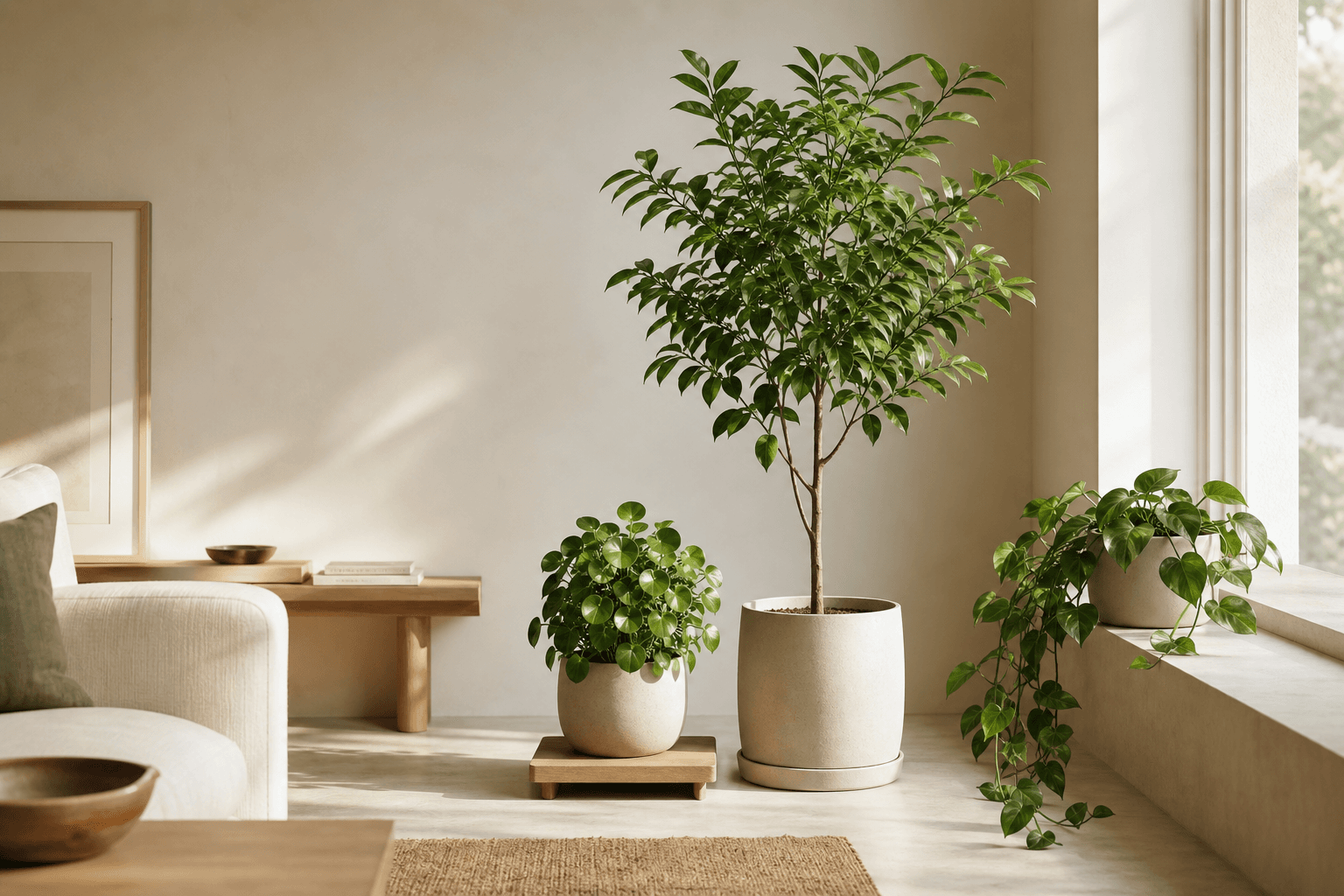
Begin with the room, not the plant
The most useful question is not “Which houseplant is best?” but “What can this particular place support?” A living room, bedroom and hallway can be only a few metres apart yet offer very different light, temperature and humidity. A room can also look bright to a person while the position behind a sofa or in a corner receives too little daylight for a plant to remain full and healthy.
Start by choosing the position before choosing a species. Notice the window direction, what sits outside it, how far the intended pot will be from the glass, and whether curtains, furniture or another plant cast shade. The Royal Horticultural Society advises matching a plant to the conditions in each room rather than treating the home as one uniform environment. That simple order prevents many disappointing purchases.
Read the light at leaf level
Light is the first boundary because it affects growth, density and watering. Check the precise point where the leaves will sit, not just the light at the centre of the room. South- and southwest-facing windows are usually the brightest; east and west light have a different intensity and duration; north-facing positions and places set back from glass are commonly much dimmer, especially in winter. Outdoor obstructions matter too: a neighbouring building or mature tree can change a seemingly bright room.
Terms such as “low light” are often used too loosely. They do not mean a windowless position. University of Minnesota Extension describes low-light houseplants as suitable for a north window or a fairly dark corner, and notes that plants in lower light grow more slowly and use less water. The RHS offers a practical check: if there is enough natural light to read by, there is generally enough for a houseplant. If the place falls short, choose a different position or use a properly planned grow light rather than asking a tolerant plant to live without daylight.
Watch the plant after it arrives. Pale or widely spaced growth, weak stems and lower-leaf loss can be signs that the position is too dim. Scorched patches can signal harsh direct sun. Moving a plant toward better light is usually more useful than compensating with extra water or fertiliser.
Measure the footprint and the future outline
A nursery plant is a temporary version of its eventual shape. Before buying, measure the available floor or shelf depth, then add room for leaves, watering and ordinary movement. A large, spreading plant beside a narrow path may look dramatic in a shop photograph but soon becomes something people brush past, avoid cleaning around, or push into a darker corner.
Think in silhouettes as well as dimensions. Upright plants create a vertical line and can work beside a chair or cabinet when there is little width. Broad leaves carry more visual weight and need open space around them to read clearly. Trailing plants use little shelf depth but require a clean route for the line of growth. A compact plant can be more useful than a large one if the available light and circulation are limited.
The container matters in the calculation. A decorative cachepot, saucer or stand adds width and height, and the plant still needs a practical way to drain after watering. Choose a pot that feels proportionate to the final role, but do not use a heavy decorative container to disguise a plant that has already outgrown its position.
Match the care to the way the room is used
A beautiful placement is only successful when it can be maintained. Consider who opens the window, where a radiator runs, whether a door creates a cold draught, and whether the pot can be reached without moving furniture. The RHS notes that living rooms can be dry in winter because of central heating, while rooms near direct heat or fluctuating temperatures can stress foliage. Those are reasons to choose carefully, not reasons to avoid plants altogether.
Be honest about your routine. A plant placed high on a shelf or tightly behind a chair is easy to forget when it needs watering, rotation or a leaf clean. A large plant may be low-effort once settled, but it still needs access. A smaller, robust choice in a visible place is often better than a more demanding specimen selected only for a particular leaf shape.
Watering should respond to conditions rather than a calendar. The same plant can dry at very different speeds in a bright warm room and a lower-light room. Check the potting mix and the weight of the pot; allow the plant’s needs, pot size and season to guide you. If it is kept inside a cachepot, remove or empty standing water after watering.
Choose a visual role, then a plant form
Once the practical limits are clear, choose the role the plant should play. A floor plant can anchor an empty corner. An upright specimen can add height beside low furniture. A rounded or broad-leaved plant can soften a hard-edged sideboard. A small plant can make a desk or windowsill feel finished without competing with the room. Giving the plant one job keeps the choice focused.
Then choose the form that performs that job under the available conditions. For a bright room with enough open floor, a substantial foliage plant may be appropriate. For a lower-light position, look first for foliage plants adapted to understory conditions rather than sun-dependent forms. For a small shelf, choose a plant whose mature size and watering needs suit the shelf—not merely one that looks neat on the day it is bought.
Avoid trying to make every empty surface green. One clear plant form with visible space around it often gives a room more calm than several unrelated pots. Repeating a restrained planter palette can connect plants without making them identical, but the plant’s health should remain the organising principle.
Use a short buying checklist
Before committing to a plant, test the decision with five questions. Does the intended position provide the light the plant needs through the weaker winter months? Does the mature outline leave a path and visible breathing room? Can you water and rotate it easily? Is the room unusually dry, hot, cold or draughty? And does the plant’s silhouette add something the room actually lacks—height, softness, contrast or a point of focus?
If one answer is uncertain, pause rather than buying the plant because it is available. Take a photograph of the intended place, note the distance from the window, and check the plant label against a reliable horticultural source. A smaller or more adaptable alternative is not a compromise when it is the one that will remain healthy and visually convincing.
The best choice is the one that can stay
A successful houseplant should not require a room to be rearranged around its weaknesses. It should have enough daylight to hold its form, enough space to grow without blocking the room, and a care routine that fits ordinary life. Start with those conditions, then choose the leaf shape, scale and planter that make the plant belong. That is how a houseplant becomes part of the interior rather than a short-lived decoration.