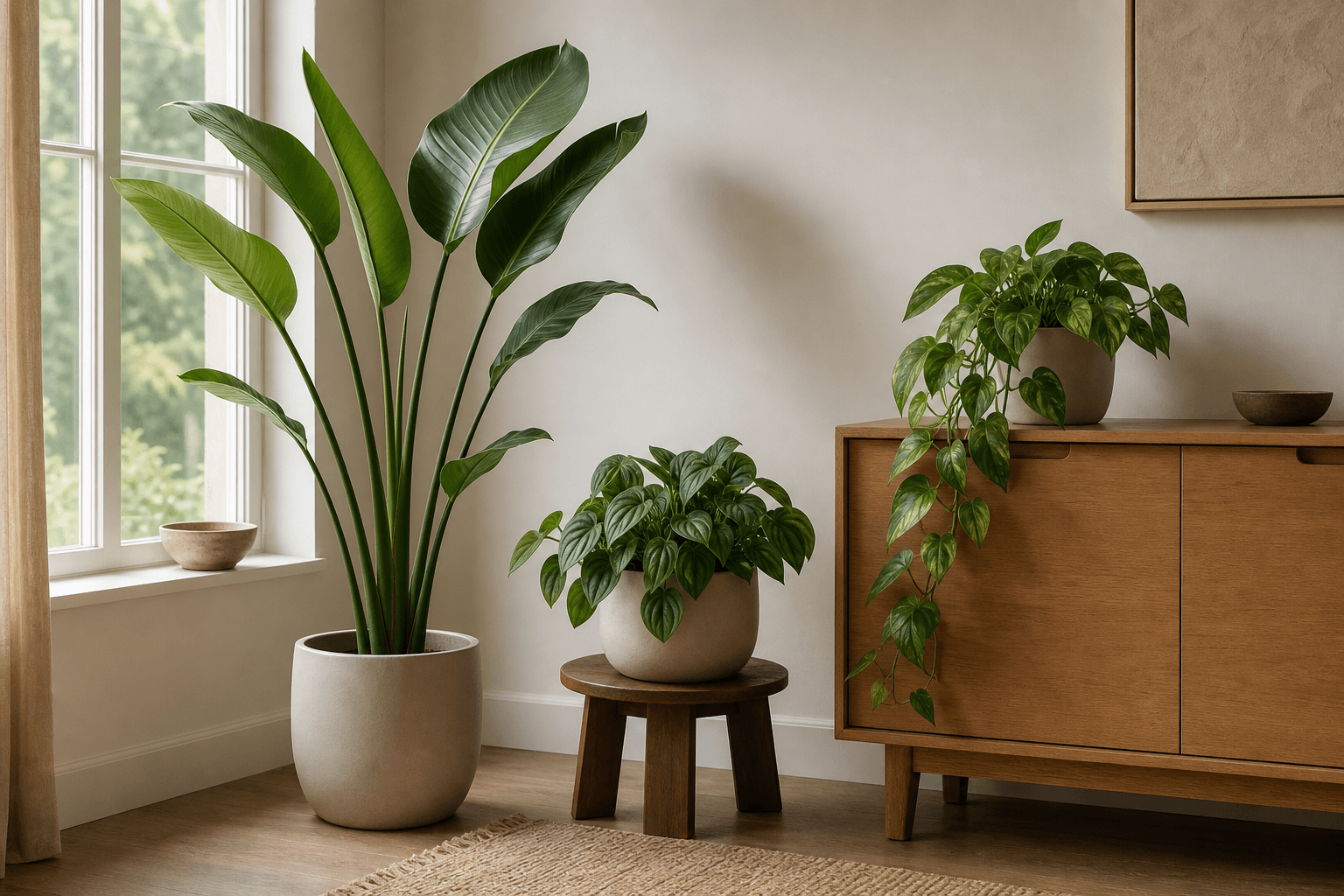
A group is more than several pots together
Plants placed on the same surface do not automatically form a composition. A useful group has a boundary: one sideboard, one floor zone beside a window, one defined shelf or a small section of a room. Within that boundary, the plants should relate through light, scale or form. Without a shared condition or a clear visual relationship, a cluster becomes storage rather than styling.
Grouping can make a room feel calmer because it reduces the number of separate points competing for attention. Instead of a small plant on every table, the eye reads one contained arrangement and several clearer surfaces. The benefit is practical as well: plants placed within the same daylight band are easier to assess together, even though they may still need different watering routines.
The first decision is where the group belongs. Choose a position with usable daylight, room to reach the pots and a background that lets the foliage be seen. A group in an empty, poorly lit corner is not rescued by its composition. The plants must be able to live there before they can make the room look better.
Begin with the overlapping light requirement
The RHS recommends choosing houseplants to suit the specific conditions of a room; that principle becomes more important when several plants share a location. Start with the light at the intended level. Is it bright indirect light beside a window, a gentler north-facing position, or a bright shelf that is slightly screened by a curtain? Select plants whose needs overlap in that band rather than adding a favourite plant that needs an entirely different location.
This does not require every plant to have the same label. One plant may prefer brighter conditions while another tolerates them, as long as neither is pushed beyond what it can manage. What usually fails is a group built around conflicting extremes: a sun-loving succulent shaded behind a broad foliage plant, or a moisture-sensitive plant placed where a neighbouring plant is routinely soaked.
Keep the group close enough to the light source that the shorter plants are not permanently shaded. Raise a small plant only when it improves access to daylight or creates a useful height relationship—not just to add another stand. If the window is narrow, two plants may make a stronger, healthier group than five crowded ones.
Give the arrangement an anchor
Every group needs one form that tells the eye where to begin. This is usually the tallest plant, the broadest-leaved plant, or the pot with the strongest visual weight. Place it first. An upright plant can create a vertical line beside furniture; a bushier plant can make a lower, wider mass. The anchor does not have to be large, but it should be unmistakably more important than the supporting plants.
The RHS’s design guidance on scale is useful here: repetition can create order, while a controlled difference in size can create a focal point. Translate that into a simple hierarchy. One plant leads; one or two plants support. If every pot is the same height and visual weight, the arrangement may look flat. If every plant is trying to lead, it becomes noisy.
Set the anchor slightly back, to one side, or at the highest point available rather than placing it in the exact centre by default. This creates depth without requiring a perfect decorative triangle. The aim is a relationship of high, middle and low—not a staged staircase of plant stands.
Use contrast with a limit
Once the anchor is in place, choose supporting forms that do a different job. A rounded plant can soften an upright plant. Fine foliage can lighten a broad-leaved silhouette. A trailing plant can draw a line down an open edge of a shelf. Contrast helps the individual shapes remain legible, but contrast in every direction quickly becomes visual clutter.
Limit the variables. If the leaves are very different, keep the pots in a related material or colour family. If the pots are varied, repeat a foliage tone or keep the growth habits relatively calm. A group does not need matching planters, but it benefits from one repeated element: terracotta and warm ceramic, a range of pale neutrals, or a similarly matte finish can be enough.
Avoid adding a plant only because there is physical room. A trailing vine that crosses books, frames and cables can make a shelf harder to read. A very dark broad-leaved plant beside two more dark broad-leaved plants can make a small display feel heavy. Remove or move one plant before buying a fourth; the absence may reveal the structure the group already has.
Plan the height without creating obstacles
Height is useful when it makes every leaf easier to see and every pot easier to reach. Use existing furniture before adding accessories: a floor, low cabinet and shelf already create different levels. A simple plant stand can lift a low plant into better light, but several stands in a small room add legs, platforms and visual interruption. They should solve a real placement problem, not become a collection of objects in their own right.
For a floor group, keep the tallest plant where it will not block a path or shade the rest. Add a medium plant beside or slightly forward of it, then use a lower plant only if the floor area can still breathe. For a shelf group, make sure the pot is not so high or deep that watering becomes difficult. A beautiful display that requires moving everything to water one plant is unlikely to remain beautiful.
Check mature size as well as the size you brought home. A group that looks balanced in the first month can become crowded when a plant puts on a wider leaf spread or begins trailing. Growth is not a failure of the arrangement; it is a reason to edit it over time.
Leave a visible edge around the group
Negative space is what allows a plant group to read as one rather than as a spill across the room. Leave part of the shelf empty. Let the outline of the anchor plant be visible against a wall. Keep an adjacent surface mostly clear instead of placing one more pot there. The space around the group is not unused; it is what makes the composition legible.
This also protects the plants. Air can move around foliage, light can reach lower leaves, and you can spot dry soil, pests or dropped leaves before they become hidden behind objects. A group should make living with plants easier, not turn basic care into an excavation.
A simple way to assemble the group
Start with two plants in the correct light: the anchor and one support. Stand back and look at the outline from where you normally enter or sit in the room. Add a third plant only when it changes the height, texture or balance in a useful way. Then remove anything nearby that competes with the group before adding another decorative object.
Live with the arrangement for a week. Check whether the plants lean toward the light, whether one shades another, whether watering is convenient and whether the group still looks calm at the times of day you use the room most. This small pause is more valuable than building a finished-looking display in one afternoon.
Let the group stay small enough to work
The strongest plant groups are often only two or three plants. They share a plausible light zone, have a clear relationship of height and shape, and leave enough empty space for the room and the plants to function. Add another plant only when it improves that relationship. If it merely fills a gap, the gap may be doing the better design work.