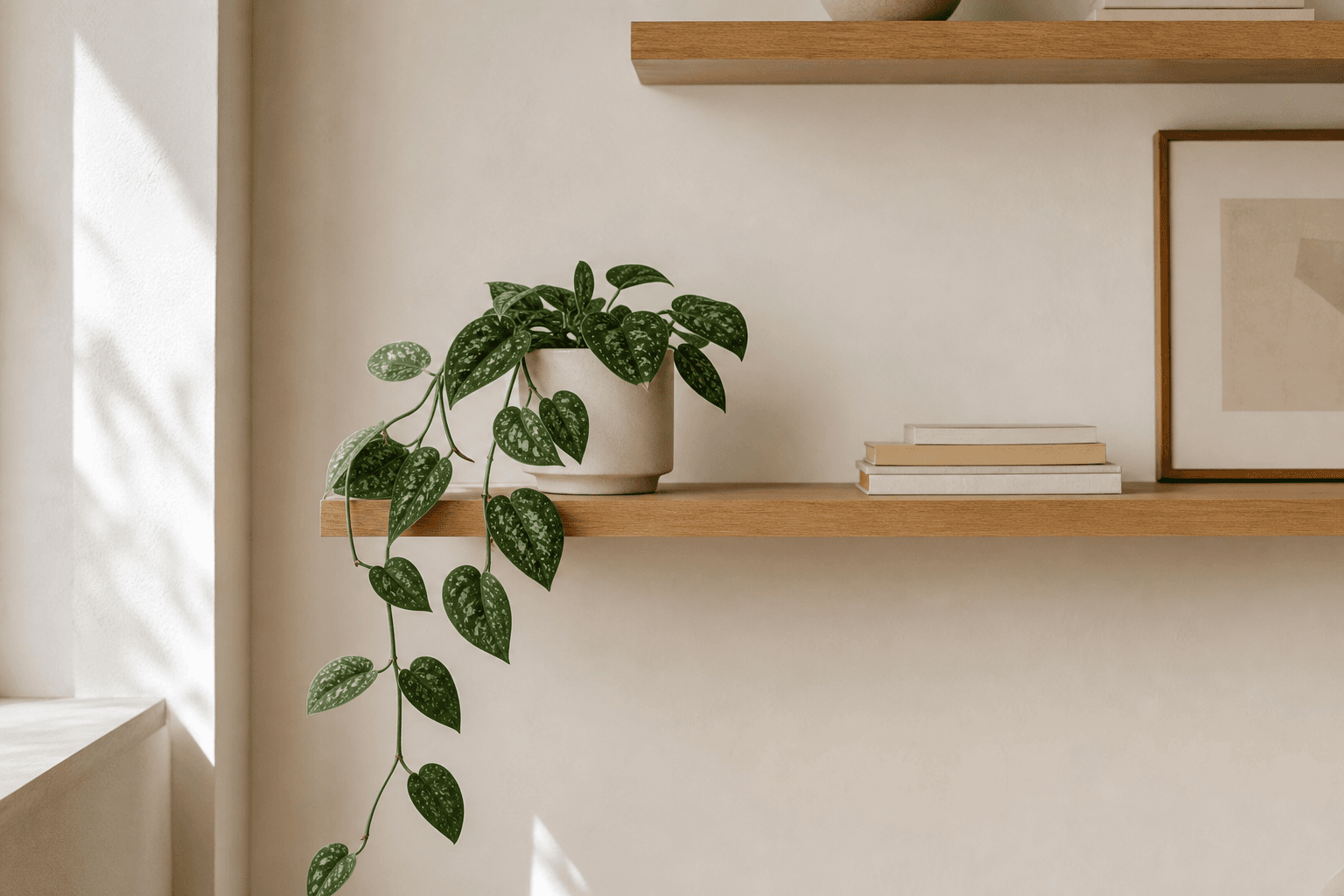
A trailing plant changes the shape of a shelf
An upright plant adds a contained silhouette. A trailing plant changes the outline of the shelf itself, drawing the eye from the pot down a wall, across an edge or toward the floor. That movement is why one well-placed vine can soften a room so effectively. It is also why several trailing plants, each spilling across books and objects, can make a shelf feel busy very quickly.
The most useful way to style one is to think of the stems as a visible line in the room. A line needs a beginning, a route and enough open space around it to remain legible. The pot is the beginning. The shelf edge, an empty side panel or a quiet stretch of wall can provide the route. Everything else nearby should help that line read, or at least not interrupt it.
Start with the light at the pot
A shelf can look bright from the middle of a room while the pot itself is set back from the window, tucked beneath a deep overhang or shaded by a larger plant. Check the conditions where the leaves begin, rather than judging from the window’s appearance. Light reduces with distance and is affected by curtains, exterior shade, furniture and the depth of the room.
Choose the plant for that actual position. Many popular trailing houseplants prefer bright indirect light, while some can tolerate gentler conditions. Tolerance is not the same as a position that will keep the plant full and proportionate. When the pot is too far from usable daylight, stems may become sparse or stretch toward the window, which makes the plant harder to style and less healthy over time.
If the strongest visual location is not suitable for the plant, change the plan. Move the shelf display closer to the window, use a smaller plant in the available light band, or add a dedicated grow light designed as part of the room. A trailing plant should not be asked to compensate for a dark shelf merely because the empty space would look good with greenery.
Choose one route for the stems
Before placing the pot, decide where the trail can go. The cleanest routes are often down an open side of the shelf, across a plain wall with enough breathing room, or toward an unoccupied section of furniture. Letting stems descend beside a bookcase can soften its vertical edge; letting them cross the face of a crowded shelf usually makes both the plant and the objects harder to read.
Avoid treating every stem as a separate decorative opportunity. A plant does not need to reach two shelves, wrap around a lamp and cross a frame to look established. Choose the strongest direction, then allow the remaining growth to support that route. You can gently reposition a flexible stem when necessary, but do not force a rigid plant into tight turns or tie growth so tightly that routine inspection becomes difficult.
Cables, picture frames, handles and book spines create visual breaks. When a vine crosses several of them, the effect can become accidental. Moving one object, changing the pot’s position by a few centimetres or shortening a single overlong stem is often more effective than adding another accessory to make the shelf feel finished.
Use the pot as the visual anchor
The pot should make the plant feel placed before the stems begin to fall. A simple, stable container gives the foliage a clear starting point and prevents the shelf from reading as a collection of loose greenery. For a narrow shelf, a pot with a modest footprint is usually easier to water and leaves room around the leaves. For a wider cabinet, a slightly more substantial pot can anchor a longer cascade without making the display heavy.
Keep drainage practical. A trailing plant placed high or deep on a shelf is not a reason to abandon an inner pot with holes. Use a cachepot, liner or saucer that protects the surface, and make sure you can remove the plant or inspect the base after watering. Water damage and trapped runoff are much harder to manage once a plant is surrounded by books and other objects.
Let the pot and foliage divide the visual work. If the leaves are strongly variegated or the stems create a dramatic line, a quiet matte container often makes the whole arrangement calmer. If the foliage is fine or understated, texture in the planter can be useful, provided it does not compete with every other object on the shelf.
Leave an edge of empty space
Negative space is not what remains after a display is complete; it is part of the display. Leave a visible section of shelf beside the pot. Let the vine have some open wall behind it. Keep the neighbouring shelf level mostly clear if that is what allows the trailing line to be seen. The plant will look more intentional when it has a boundary instead of spreading through every available gap.
This is especially important on bookcases. Books already make a dense pattern of vertical and horizontal lines. A single trailing plant can interrupt that pattern pleasantly; several can conceal it and make the whole unit feel overfilled. Give the plant one shelf or one edge to work with, then preserve the bookcase’s original rhythm elsewhere.
Do not add a trailing plant simply because a shelf has an empty corner. An empty corner may be doing useful visual work. If the pot has no light, no room for a safe saucer or no clear route for the stems, leave the shelf open and use a plant in a location that can genuinely support it.
Keep the display workable
A shelf arrangement is only successful if it can survive ordinary care. You should be able to reach the pot, check the potting mix, lift the inner pot when needed and wipe the shelf after watering without dismantling a whole composition. Avoid placing a plant above seating or electronics where runoff, dropped leaves or routine pruning will become a recurring problem.
Growth changes the arrangement. A stem that once ended neatly at the shelf below may eventually reach the floor, catch on a drawer or begin to obscure the object that balanced the display. Regular trimming or a small repositioning is not a failure of styling; it is the normal maintenance of a living plant. Remove damaged or bare sections when necessary, and take cuttings only if you have a realistic place for more plants.
Dust is more visible on a high shelf and can make a healthy plant look neglected. When you water, take a moment to check leaf surfaces, the shelf edge and the area behind the pot. A clean, accessible setup usually looks more composed than a more elaborate arrangement that is difficult to maintain.
Use trailing plants in groups sparingly
A trailing plant can work beside an upright or rounded plant when both have compatible light needs and the group remains small. Give one plant the leading role. If the trailing plant is the line, let the upright plant act as the anchor and keep the pots related through colour or material. If the foliage is already visually active, remove rather than add a third plant.
Two vines can work when they have clearly separate routes—for example, one down each end of a wide console—but they need enough distance that their stems do not overlap into a curtain. On an ordinary shelf, one is usually enough. The goal is not to prove that the shelf can hold plants. It is to create an arrangement whose living growth has a visible purpose.
A simple reset for an overfilled shelf
Remove every plant and object from the shelf or shelf section.
Return the trailing plant to the brightest workable position and choose one direction for its stems.
Add one supporting object or plant only if it improves the scale or balance.
Leave a section of the shelf and the wall around the vines visibly clear.
Live with the result for a week, adjusting for light, watering access and new growth before adding anything back.
Let the line do the work
A trailing plant is at its best when it has room to be read as one calm, living line. Start with enough light at the pot, choose a simple route, protect the shelf and preserve the empty space around the growth. The result does not need to look perfectly arranged. It only needs to allow the plant, the shelf and the room to remain useful together.