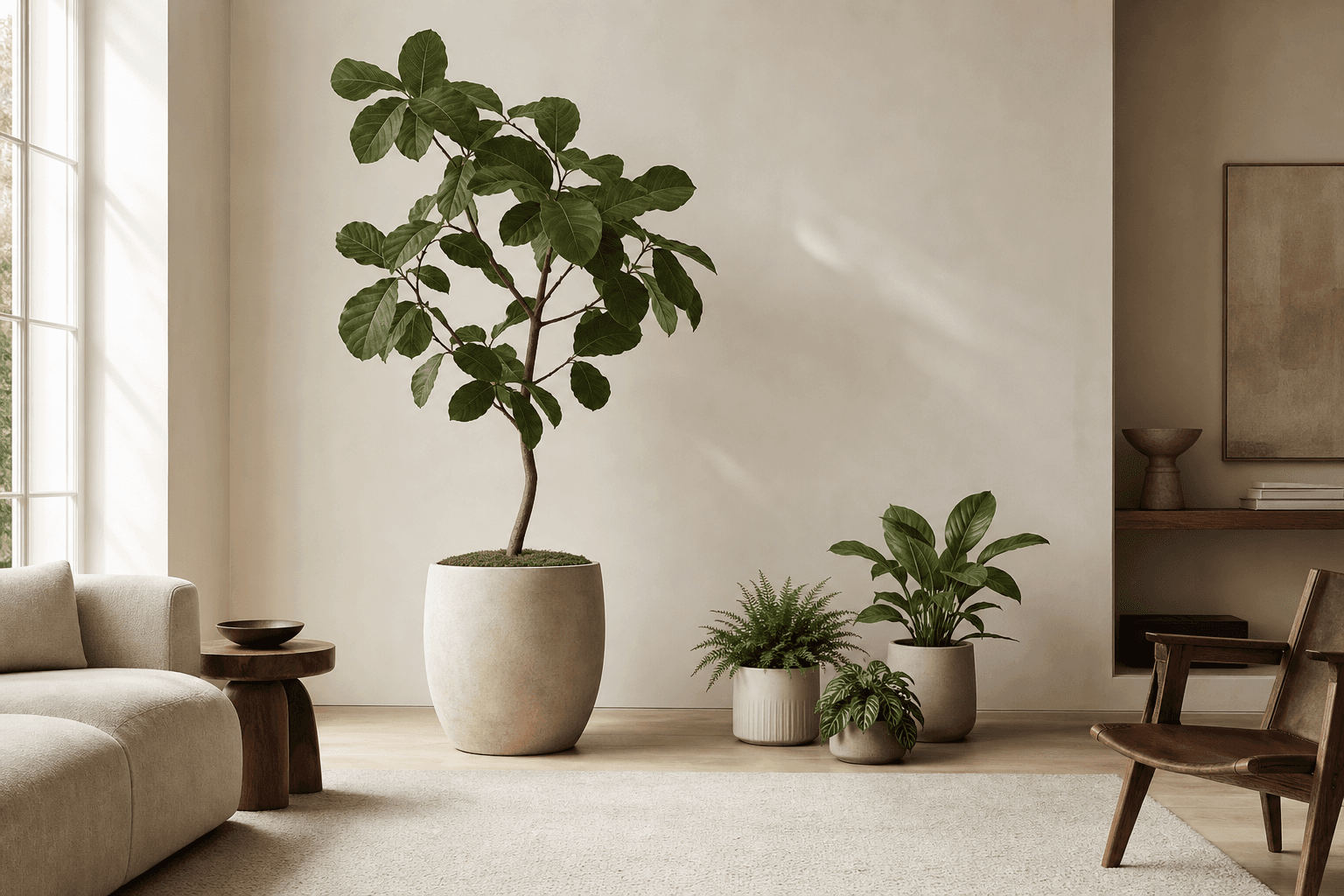
Start with the room’s visual problem
The question is not which option is more decorative. It is what the room needs. An empty corner beside low furniture may need one vertical plant to give the room a clear edge. A long sideboard or a wide bright window may benefit from a small group that creates rhythm across a horizontal surface. A room already full of books, art, objects and patterns may need less visual activity, not more plants in more places.
Look at the room from its usual viewpoint. Where does the eye stop? Is there an awkward gap, a heavy piece of furniture with nothing balancing it, or a collection of scattered small pots that all demand equal attention? A plant decision is easier once you identify the visual job. The plant should make the room more legible, not merely occupy spare space.
The RHS’s guidance on scale is a useful starting point: repetition can create order, while a clear difference in size can create a focal point. In a home, that becomes a practical decision. Use one substantial form when the room needs a focal point. Use repeated smaller forms when the room has a defined surface or light zone that can hold a group.
When one large plant is the better answer
A substantial plant works best when there is enough open floor, usable daylight and a reason for height. Beside a chair, at the end of a sofa, near a bright window or in a generous corner, one upright or broad-leaved plant can create a stable visual mass. It is particularly useful in a room where the rest of the furniture is low, linear or visually busy. One plant can give the eye a place to land without adding many separate objects.
The advantage is not simply size. A large plant creates one care routine, one pot, one source of visual weight and one mature outline to plan for. It may be easier to keep a room orderly than five small pots spread over different surfaces. But a large plant is only the calm option when its future spread and maintenance are realistic. A floor plant that blocks a path, shades a room or needs to be squeezed behind furniture will not feel calm for long.
Choose a naturally upright or contained form for a narrow space rather than a broad plant you hope to control constantly. Leave room to water, rotate and clean around it. The mature canopy matters as much as the pot footprint. The correct large plant should still allow people to sit, pass through the room and open curtains without negotiating its leaves every day.
When several smaller plants make more sense
Several smaller plants are useful when the room has a clear place for a contained display rather than one large empty floor zone. A sideboard near a window, a broad sill, a deep shelf with genuine daylight, or a low cabinet can hold two or three plants with a shared relationship of height and form. The emphasis is on contained. Plants distributed onto every available table and shelf do not create a group; they create many separate visual stops.
Smaller plants can give you more flexibility. They can be moved to follow seasonal light, rearranged as they grow and combined to create a mix of upright, rounded and trailing forms. They are often better for a rental, a room with limited floor space, or a home where the brightest positions are on surfaces rather than on the floor. They also allow you to test a composition before committing to a large statement plant.
The trade-off is maintenance. Several pots may have different soil, drying speeds and plant needs even when they share the same window. They require more decisions about drainage, saucers, dust, pests and space. Choose several smaller plants because the room benefits from a small composition, not because each one seemed too good to leave behind.
Compare the footprint, not the nursery size
A young large plant can look modest in a shop, and a collection of small plants can appear harmless when each pot is viewed separately. At home, both choices need a footprint calculation. Mark out the base of the pot, then add the likely leaf spread and a route for care. For a group, include the gaps between pots, the space for a tray or saucer, and the surface that should remain visible around the arrangement.
A single plant may take less visual space than three small ones if its leaves make one strong outline against a quiet wall. Conversely, a very broad plant may be too much for a compact room even if the pot itself fits. Physical dimensions and visual weight are related but not identical. Dark glossy leaves, thick ceramic pots and dense foliage generally feel more substantial than fine leaves and pale, open forms of the same height.
Do not plan only for the first month. Plants grow toward light, gain width, need larger pots and sometimes change shape after pruning. A choice that leaves a little useful empty space at the beginning is more likely to continue working as the plant becomes part of the room.
Match the option to the available light
The best-looking plan still has to respect conditions. One large floor plant may need the brightest available location; if that location is occupied by a doorway or does not have enough clearance, the plant is not a good answer. Several smaller plants may be easier to place near a window, but they should not be stacked in a way that shades lower leaves or turns a sill into a dense barrier to light.
The RHS advises matching houseplants to the particular conditions of a room, including light, humidity and temperature. Treat this as a filter before considering style. In a lower-light room, a modest, tolerant plant group may be more realistic than one dramatic light-hungry tree. In a bright room, you have more freedom, but direct summer sun, dry air near radiators and seasonal change still matter.
If the room’s best light is on one sideboard, build the group there rather than forcing a floor plant into the back of the room. If there is one bright, open corner, a larger plant may be the stronger choice. Let the conditions decide which scale is plausible, then use the form to improve the room.
Use a simple decision test
Choose one large plant when you can answer yes to these questions: does the room need a single anchor, is there a bright enough position with open floor around it, and can the plant’s mature spread remain clear of circulation? Choose several smaller plants when you have a defined surface in good light, can keep the display contained, and want a layered rather than singular visual effect.
If neither option fits comfortably, do less. One medium-sized plant in the correct location is often better than an oversized plant or a collection of small pots trying to fill every gap. Plant styling does not improve by adding units. It improves when scale, light and empty space agree.
Make the scale serve the room
The strongest choice is the one that clarifies the room. A large plant should act as one calm anchor. Several small plants should read as one deliberate group. Once the plants begin competing with furniture, blocking light or creating more maintenance than the room can support, the scale is wrong. Start with the available conditions and the visual job, then choose the simplest plant arrangement that genuinely solves both.