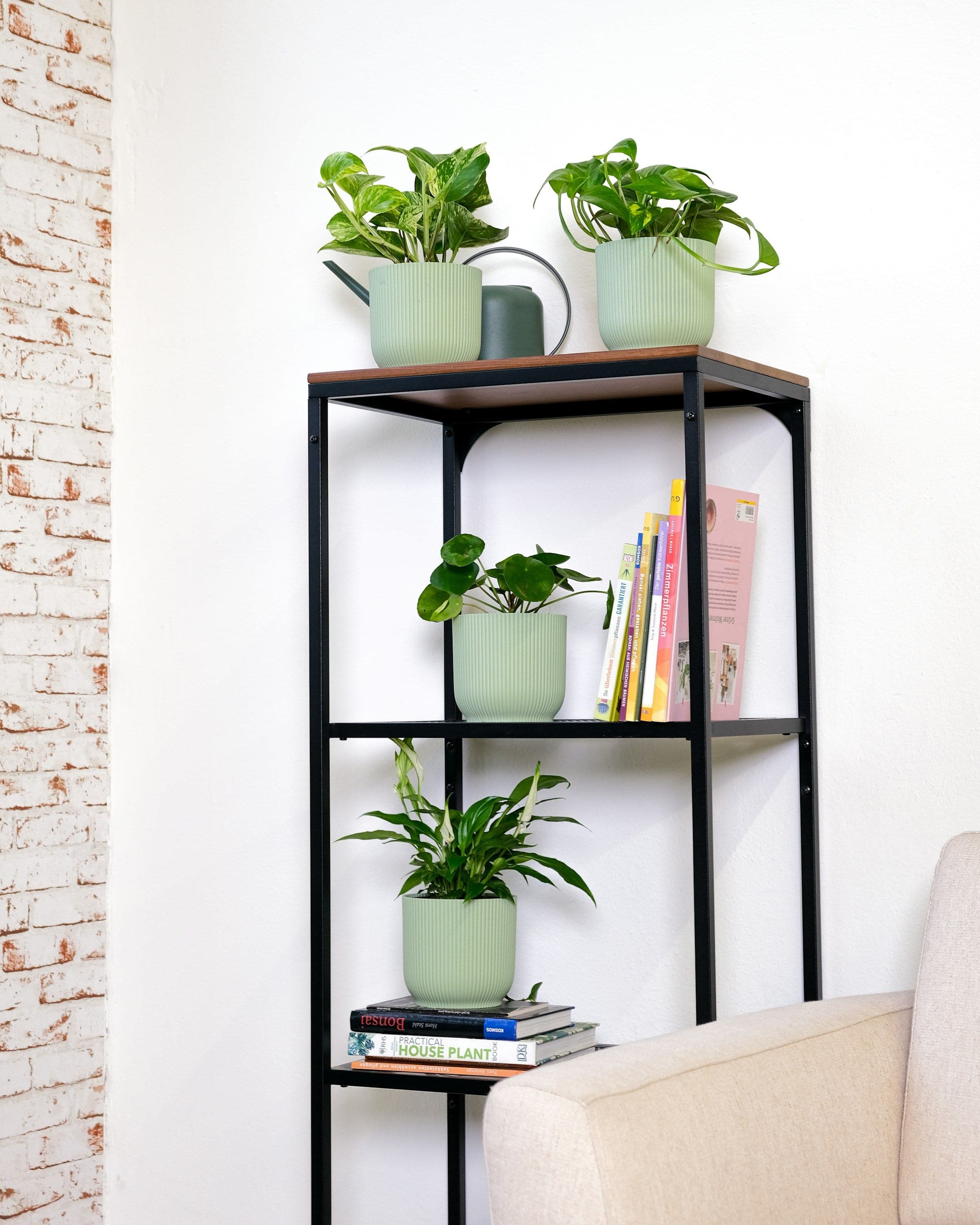
A rental does not need a wall of hanging pots to feel planted. In many rooms, the safest and most convincing arrangement uses no wall hardware at all: one floor plant, a small group on a sturdy cabinet, or a freestanding shelf positioned close enough to the window for the plants to grow well.
“Damage-free” hardware can still mark an unsuitable surface or fail under a watered pot. Tall furniture can still need anchoring. A tension rod can still slip. The goal is not simply to avoid a drill; it is to create a display that respects the lease, keeps plants healthy, and remains stable through watering, cleaning, pets, and everyday movement.
Check the lease, the surface, and the light first
Read the lease and building rules before attaching anything to a wall, ceiling, trim, window frame, or balcony. If the language is unclear, ask the property owner or manager in writing. A removable product is not automatically permitted, and a small approved hole may sometimes be safer and easier to repair than an improvised no-drill support. This article is practical design guidance, not legal advice about a particular tenancy.
Then assess the exact surface. Wallpaper, textured plaster, fresh paint, unsealed masonry, and delicate finishes do not behave like smooth cured paint. Even a product marketed as removable must be compatible with the actual wall and installed exactly as instructed.
Finally, read the daylight before choosing a display. The Royal Horticultural Society and University of Minnesota Extension both emphasize matching the plant to the light at its intended position. A shelf on the room's darkest wall is not a success because it leaves the window unobstructed. If the plants need to be several feet from the glass, choose genuinely lower-light species or add a horticultural grow light.
1. Begin with one floor plant
A floor plant is the simplest no-drill display and often the strongest visually. One substantial silhouette beside a window, cabinet, or sofa can give the room a clear green anchor without consuming every sill and tabletop.
Measure the mature width, not only the nursery pot. Keep the leaves and container out of the main route through the room, away from doors, radiators, and air vents. The position must also remain accessible for watering and cleaning; a plant wedged behind furniture will eventually be neglected or dragged across the floor.
Use a watertight saucer or cachepot and a floor-safe protective layer. Penn State Extension recommends a draining inner pot, a drip tray for surfaces that are not waterproof, and removing excess water from the cachepot after watering. A rental deposit is easier to protect when runoff is visible and the floor beneath the pot is checked regularly.
2. Use sturdy furniture you already have
A sideboard, low bookcase, media unit, or console can become a plant zone without adding another object to the room. Group two or three plants that share similar light rather than spreading single pots across every piece of furniture. Repeated pot colors or one material family can make the group feel intentional even when the plants differ in height.
Check the furniture manufacturer's load guidance and protect the top from water. Put heavier pots low and close to the furniture's supports rather than at the unsupported center of a long shelf. Do not block doors, ventilation slots, electronics, or the working surface of a desk.
Furniture safety overrides the no-drill brief. The U.S. Consumer Product Safety Commission advises anchoring top-heavy furniture such as bookcases and dressers. If a tall unit is designed to be secured to the wall, ask for permission to install the correct restraint or choose a lower, more stable piece. Adding wet pots high on an unanchored bookcase can make the center of gravity worse, especially around children or climbing pets.
3. Make the most of a real windowsill
A deep windowsill gives small plants direct access to light without adding furniture or wall hardware. It works best when the window can still open, close, lock, and be cleaned normally. Keep foliage clear of blinds and cold glass, and do not place a pot where opening the window can knock it down.
Strong summer sun can scorch plants that prefer indirect light, while a winter sill may become cold. Observe the exposure over a full day and through seasonal changes. Use a stable tray with a raised edge so several small pots read as one composition and any runoff is contained.
Do not extend a narrow sill with an improvised board unless the support is designed and rated for that use. A watered pot is heavier than an empty decorative object, and the repeated movement of blinds or curtains introduces side loads that a simple balancing shelf may not tolerate.
4. Choose low, stable freestanding stands
A purpose-made plant stand can lift foliage into better light and create variation in height without touching the wall. The most useful renter-friendly stand has a broad base, a clear weight rating, and a top that holds the pot securely. Test it on the actual floor; a stand that rocks on uneven boards or deep carpet is not suitable for a tall plant.
Use one stand where it solves a specific proportion problem rather than building a forest of small pedestals. Raising a compact plant to the height of a window or above the arm of a sofa can be enough. Keep stands out of circulation and do not use a narrow pedestal to place a heavy plant beyond the reach of a pet or child.
Freestanding pole systems and tension-mounted plant stands need the same discipline. Follow the manufacturer's approved ceiling and floor surfaces, span, installation method, and total load. Weigh the plant with wet potting mix, its inner pot, saucer, and decorative container—not just the dry nursery label. Recheck tension periodically and never position a suspended pot over a bed, chair, play area, or valuable object.
5. Treat adhesive hooks as a limited tool
Adhesive hooks are useful for light objects, but they should not be the default support for a water-filled plant. 3M's current Command product guide assigns a specific load limit to each hook, and its instructions restrict the surfaces and conditions where the adhesive can be used. The company also says not to combine multiple hooks to support an item heavier than the package rating.
If a particular product does not explicitly approve the surface, orientation, environment, and total loaded weight, do not use it to suspend a pot. Water, humidity, textured paint, wallpaper, fresh paint, and heat can all change the situation. Follow the exact cleaning, curing, pressing, and waiting instructions on the current package; do not copy a social-media shortcut.
Adhesive clips are better reserved for guiding a very light vine, organizing a grow-light cable, or holding a small nonvaluable accessory within the product's instructions. Even then, leave slack for plant growth and remove the adhesive using the manufacturer's method. Do not let a plant stem become the safety tether for its own pot.
6. Use existing architectural features only as intended
Some rentals already have picture rails, ceiling hooks, curtain tracks, exposed beams, or built-in shelving. Existing does not automatically mean load-bearing. Ask what each feature is intended to hold and inspect it for looseness, corrosion, or previous damage before adding weight.
Curtain rods and shower rods are especially easy to overestimate. A rod designed for fabric is not automatically a plant rail, and a pressure-mounted shower rod is not a universal hanging system. If the manufacturer does not provide a relevant load rating for the installed span and orientation, keep plants off it.
Over-door hooks avoid wall holes but move every time the door opens. They can mark trim, interfere with closing, or swing a pot into the wall. Use the back of a door for lightweight tools or an empty watering can instead of a live plant unless a purpose-made system explicitly supports the full dynamic load.
Build a portable composition, not a scattered collection
Rental rooms benefit from displays that can move as one idea. Create one floor-level anchor and one smaller raised group rather than placing a plant on every available surface. This preserves working space and makes watering, floor protection, and moving day easier.
Use repetition to bring order: two or three cachepots in related colors, one tray across a windowsill, or a single freestanding shelf with visible gaps between plants. Negative space is particularly important when the furniture and wall colors cannot be changed. The plants should make the room feel more settled, not more temporary.
Keep the light hierarchy visible. Put the highest-light plants nearest the window and lower-light plants farther back only within their real tolerance. Rotate plants for balanced growth when appropriate, but do not use rotation to justify a position that is consistently too dark.
Protect every surface from water and scratches
Every plant needs functional drainage whether the home is owned or rented. Keep a draining nursery pot inside a watertight outer container, or use a sturdy saucer large enough for a thorough watering. Empty standing water after the pot drains.
Add clean floor-safe pads beneath dry outer containers and inspect under them regularly. On shelves and sills, use a waterproof tray rather than a decorative textile that can hide moisture. Wipe spills immediately and keep grit away from the base of heavy pots before moving them.
When possible, water small plants at a sink and return them after they drain. For large pots watered in place, add water gradually and remove runoff with a removable saucer, sponge, or small pump. The display is only renter-friendly if it can be maintained without staining the floor or swelling the furniture.
What to avoid
Avoid an unanchored tall shelf loaded with pots, a tension rod with no relevant load rating, or an adhesive hook chosen by appearance rather than its instructions. Do not suspend plants above sleeping or seating areas. Do not place a pot where a door, blind, pet, or person will repeatedly strike it.
Also avoid designing around the property rather than the plants. A dark wall may be the only blank surface, but it is not useful growing space without adequate supplemental light. A beautifully damage-free display of declining plants is still a failed arrangement.
The best rental plant display is easy to inspect, water, move, and remove. Start with the floor and existing furniture, add one stable freestanding element only when it solves a real need, and treat every removable attachment as a product with limits—not a promise. The result can feel permanent in the room while remaining practical when the lease ends.
---