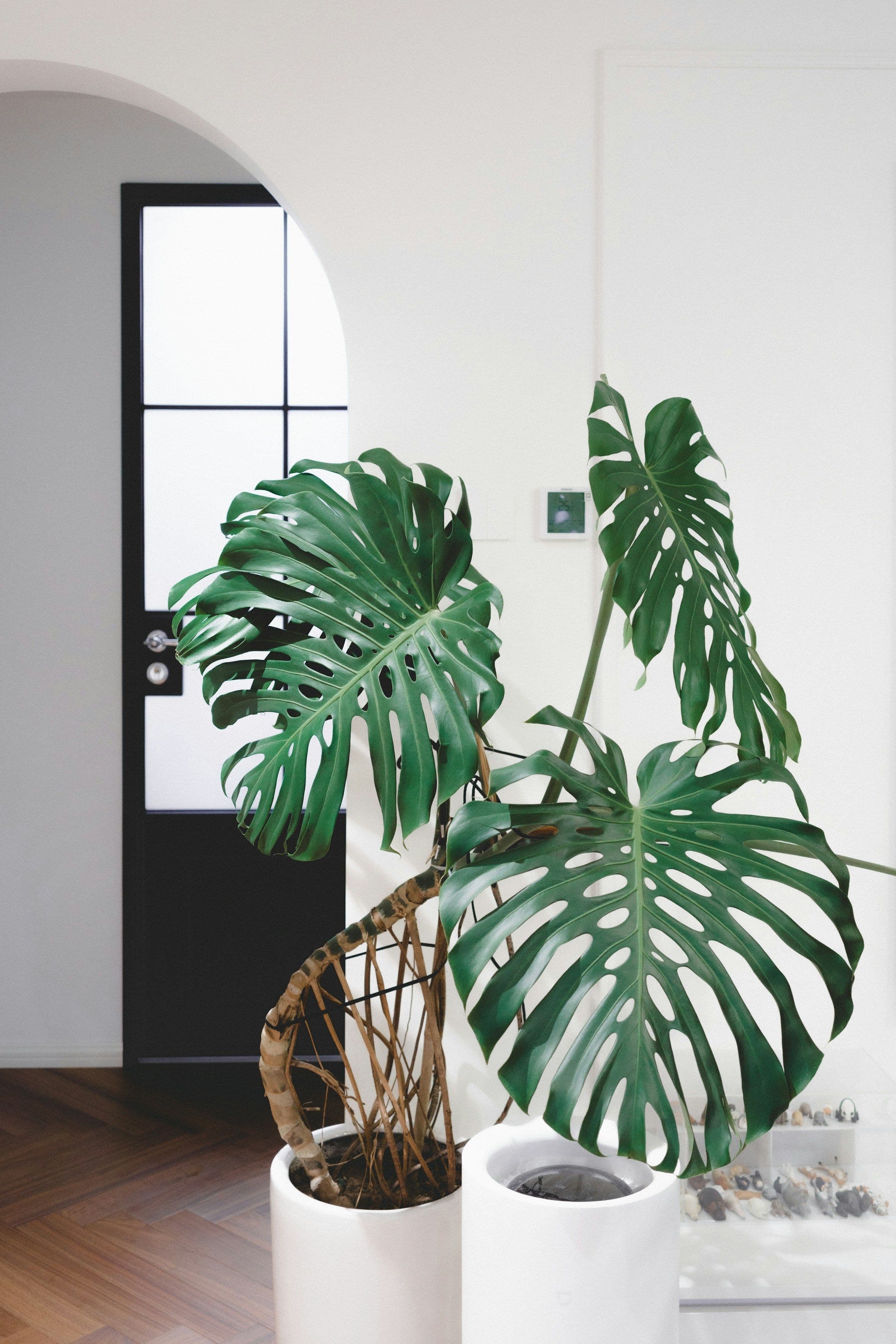
The best architectural houseplants have a form you can understand from across the room: a column of upright blades, a sparse canopy on narrow canes, a fan of broad leaves, or one large divided outline. They do not need to be rare, oversized, or arranged in a collection. Their structure is the point.
For the most adaptable vertical shape, start with a snake plant or dragon tree. Choose a rubber plant when you want a denser broadleaf tree, and a supported Monstera when the room can accept a wider, more irregular form. White bird of paradise, ponytail palm, spineless yucca, and fiddle-leaf fig are more dependent on strong light, sufficient space, or stable care. The right choice is the plant whose form can remain healthy in the exact position—not the one that looked most sculptural in a greenhouse.
What makes a houseplant architectural?
An architectural plant has a clear structural idea. Its stems and leaves create a repeated direction, recognizable mass, or strong outline instead of dissolving into general greenery. A snake plant reads as a vertical cluster. A dragon tree reads as fine lines held above bare canes. A mature Monstera reads as a wide framework of divided leaves and climbing stems.
Scale helps, but scale is not the definition. A compact ponytail palm can be more sculptural than a large, shapeless plant because its swollen base and fountain-like crown remain visually distinct. Conversely, an overgrown plant with unsupported stems may be large without giving the room useful structure.
The form also has to survive ordinary life. Leaves that are repeatedly brushed in a passage, a trunk leaning toward inadequate light, or a pot hidden where it cannot be watered will not preserve the silhouette that justified the purchase. Architecture here means a living framework, not a static prop.
Choose the silhouette before the species
Stand where the plant will be viewed and decide what shape the room is missing. A low room with heavy furniture may benefit from a narrow vertical line. A broad blank wall can hold a wider fan or divided leaf. A room already full of patterned textiles and small objects usually needs one quiet form rather than another busy layer.
Then measure the usable space at leaf height, not only the empty floor. Broad petioles and arching leaves can extend well beyond a nursery pot. Allow clearance from doors, curtains, radiators, vents, and the route people use through the room. Check whether the plant can be rotated, cleaned, and watered without moving furniture.
Finally, read the light at the leaves. University of Minnesota Extension recommends matching indoor plants to the light actually available, noting that light changes with window direction, distance, season, curtains, and outdoor obstructions. “Architectural” is not a light category. Two equally graphic plants can require very different positions.
1. Snake plant: the strictest vertical form
Snake plant, now classified within the genus Dracaena, is the clearest choice when floor area is limited but the room needs an upright shape. Its leaves rise from the soil without a branching crown, so the silhouette stays contained. A tall green cultivar can read as one dark vertical mass; yellow-edged forms add contrast and become visually busier.
North Carolina State Extension describes dracaenas as varying from erect canes to basal rosettes and notes that indoor sizes differ considerably by species. Snake plants tolerate less light than the sun-oriented choices later in this list, but tolerance is not the same as useful growth in darkness. Brighter indirect light generally preserves a denser, more convincing form.
Use one substantial pot rather than a row of small matching plants. Keep the leaf tips out of circulation paths, where rigid foliage is easily damaged. This is the strongest option for a narrow wall return, the side of a cabinet, or a restrained bedroom composition—provided the position still receives daylight.
2. Dragon tree: height without a heavy canopy
Madagascar dragon tree, commonly sold as Dracaena marginata and currently treated botanically as Dracaena reflexa var. angustifolia, creates height with less visual weight than a broadleaf tree. Narrow leaves radiate from slim canes, leaving portions of the wall and room visible through the plant.
That openness is useful beside desks, low storage, and furniture with clean horizontal lines. A single straight cane is spare and graphic; several canes at staggered heights make a fuller but still airy composition. Buy the cane structure you want rather than assuming a small plant will quickly become a branched specimen.
North Carolina State Extension recommends a well-draining mix and allowing the plant to dry between waterings without letting it become severely dry. It is more adaptable than bird of paradise or yucca, but a position with useful indirect light will produce a better crown than a remote corner. Dracaenas are also listed as toxic to cats and dogs if ingested, so this is not the default for a household with pets that chew foliage.
3. Rubber plant: a calm broadleaf tree
Rubber plant, Ficus elastica, has large, glossy leaves arranged around a woody stem. It supplies more visual mass than a dragon tree but remains more regular and contained than a mature Monstera. Dark green forms are quiet and weighty; burgundy or strongly variegated cultivars become a more assertive color decision.
The plant can be trained as a tall, narrow specimen or pruned to branch. North Carolina State Extension notes that indoor plants are commonly maintained between roughly 2 and 10 feet and can become heavy, making them better suited to spaces that can support the pot and eventual crown. Bright indirect light and protection from harsh afternoon sun are sensible starting conditions.
Choose rubber plant for a room that needs a solid green volume rather than a spreading fan. Give the crown space instead of pressing it flat against a wall. Its milky sap can irritate skin, and the plant is not appropriate where children or pets are likely to ingest it; wear gloves when pruning and verify current safety guidance for the exact plant.
4. Monstera: a wide, articulated framework
Mature Monstera deliciosa leaves are large, divided, and perforated, so the plant combines visual weight with open space. It can look almost drawn into a room: each leaf has a recognizable outline, while gaps allow the background to remain part of the composition.
This is not a naturally self-contained floor plant. North Carolina State Extension identifies Monstera as a climbing vine and recommends sturdy support. Without a support and regular direction, stems can travel horizontally and the plant can occupy far more room than its pot suggests. A pole or board should be planned as part of the silhouette rather than added after the plant collapses outward.
Use Monstera where there is a broad zone near useful filtered light, not in a narrow passage. One mature supported plant is usually enough. The leaves and stems contain irritating calcium oxalate crystals, so keep it away from pets and children that may chew it. For a deeper placement and support guide, see Monstera Deliciosa in the Home.
5. White bird of paradise: the largest indoor fan
White bird of paradise, Strelitzia nicolai, creates long stems and broad banana-like leaves in an upright fan. It has the visual authority people often mean when they ask for an architectural houseplant—but it also has one of the largest realistic footprints on this list.
North Carolina State Extension recommends bright indirect light, well-drained soil, warmth, and protection from cold drafts. The species becomes enormous outdoors, and even container-grown indoor specimens can push leaves into walls, ceilings, curtains, and walkways. Torn leaves are normal in the plant's life, but repeated mechanical damage from a cramped position makes the whole form look compromised.
Choose it only when the room has a bright position and open volume around the crown. Do not buy it as a way to make a dark corner feel tropical. Its parts are listed as toxic to people and pets if ingested. The full Bird of Paradise indoor guide covers its light, scale, and placement limits.
6. Ponytail palm: a compact object with an eccentric base
Ponytail palm, Beaucarnea recurvata, is not a true palm. Its swollen water-storing base and long, narrow leaves create a distinctive trunk-and-plume form, even at a moderate size. It works when a room needs an object with character rather than a wall of foliage.
North Carolina State Extension describes it as slow-growing, drought-tolerant, and best in a sunny window with fast-draining soil. That slow growth is useful in a considered interior because the silhouette changes gradually, but it also means a small bargain plant will not quickly become a tall floor specimen.
Give the leaf fountain clear space to fall. A pedestal can raise a smaller plant, but the support must be broad, stable, and able to carry the full wet pot. This is a strong choice for bright, dry rooms where a moisture-loving tropical would be a poor fit.
7. Spineless yucca: hard structure for the brightest position
Spineless yucca, Yucca gigantea, has thick woody canes topped by spiral rosettes of stiff linear leaves. It is more rigid and sun-oriented than a dragon tree, producing a dry, graphic character that suits rooms with hard lines and strong daylight.
North Carolina State Extension recommends full sun to partial shade, excellent drainage, and caution with overwatering. Although its common name distinguishes it from sharper yuccas, the leaves still project into the room and need clearance. The plant can grow quickly under favorable conditions and become difficult to handle in a large, heavy container.
Use yucca near the brightest appropriate window, where its crown can remain compact. Do not substitute it for a low-light corner plant because the silhouette will weaken as growth stretches. The leaves and roots are listed as toxic if ingested, and sap may irritate skin.
Where the fiddle-leaf fig fits—and where it does not
Fiddle-leaf fig, Ficus lyrata, is undeniably sculptural: large, coarse leaves create a broad vase-shaped crown over a woody stem. It deserves consideration when a stable, bright position can remain undisturbed. It does not deserve to be the automatic answer to every styled living room.
North Carolina State Extension notes sensitivity to overwatering, direct afternoon sun, temperature fluctuations, and both excessive and insufficient water; those stresses can cause scorch, spotting, or leaf drop. Because the remaining foliage is the architecture, visible loss has a larger design effect than it would on a dense, fine-leaved plant.
Choose a fiddle-leaf fig if the room offers appropriate light, steady temperatures, enough width for the crown, and a care routine you can maintain. Choose rubber plant for a more forgiving broadleaf form, dragon tree for less visual weight, or yucca for a brighter, drier position. A demanding plant is not a better design object merely because it is familiar from photographs.
Style one architectural plant as one decision
Give the plant enough negative space for its outline to register. If every leaf overlaps art, shelving, curtains, and smaller pots, the structural quality disappears. Move decorative objects away before adding more plant material.
Keep the planter visually quieter than the foliage unless contrast is intentional. A plain cylinder, tapered pot, or restrained cachepot lets a complex leaf outline remain primary. The container must still provide or accommodate drainage, fit the root system, and remain stable under a tall crown. Never use a narrow elevated vessel simply to make the plant look taller if the assembly can tip.
Position the plant in relation to the room's real geometry: beside a low console, at the end of a long wall, or where a canopy can balance a broad piece of furniture. Avoid centering every object. A plant often works better slightly off-axis, where its irregular living form can counter the straight lines around it.
Keep the structure healthy after the photograph
Rotate only when it suits the species and support; a climbing Monstera attached to a pole is not managed like a freestanding pot. Clean broad leaves gently so they can use available light, inspect stems and leaf undersides for pests, and change watering with actual soil moisture and seasonal growth rather than a rigid calendar.
Watch the form for practical signals. A crown leaning hard toward the window usually needs a better position. Long weak growth suggests the plant is not receiving the conditions that produced the compact specimen you bought. A top-heavy pot, roots escaping the container, or a plant that cannot be watered without dragging it across the floor indicates that the display needs adjustment.
Pet and child safety is species-specific. Common names such as “rubber plant” can refer to different plants, so confirm the botanical name and consult a veterinary poison resource before purchase. This article is general horticultural and design information, not veterinary or medical advice. If ingestion or a reaction is suspected, contact an appropriate medical professional or veterinarian promptly.
The final choice should be simple: snake plant for a narrow vertical mass, dragon tree for airy height, rubber plant for a calm broadleaf tree, Monstera for a supported divided framework, white bird of paradise for a large bright fan, ponytail palm for a sunny compact sculpture, and spineless yucca for hard structure in strong light. If the room cannot support the plant's light, mature spread, weight, and care, the silhouette does not belong there—however good it looked in the nursery.