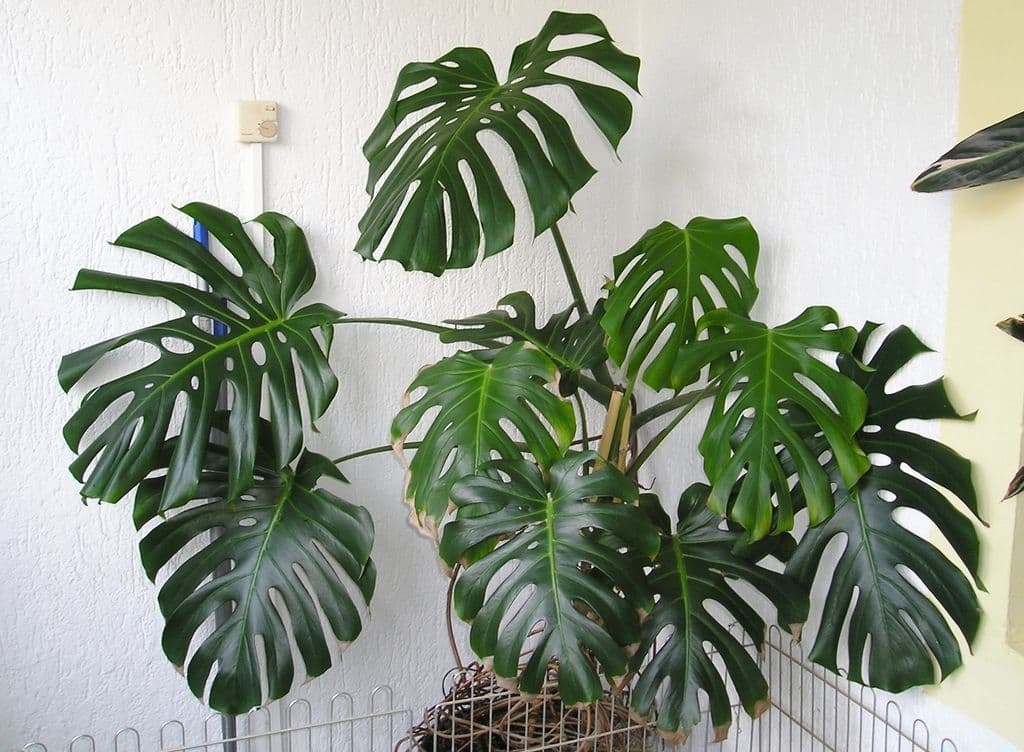
Monstera deliciosa can give a room one broad, architectural shape instead of many small decorative details. Its glossy leaves, long stems, and irregular perforations have enough presence to anchor a living area, dining room, or bright home office. A healthy mature plant can make an otherwise plain wall or empty end of a room feel considered.
It is not, however, a compact ornament that will politely remain inside the gap where it was first placed. Monstera is a climbing plant. Indoors, it still wants to move upward, lean toward light, produce aerial roots, and spread large leaves away from its support. The plant works best when that behavior is planned for rather than continually corrected.
The direct answer is simple: choose Monstera deliciosa if you have good natural light, a stable position, a strong vertical support, and room for a plant that will become visually substantial. Choose something narrower or more tolerant of dim conditions if the only available position is a dark corner or a tight passage.
Why Monstera works visually
Monstera has an unusually readable silhouette. Each mature leaf is large enough to register from across a room, while the cuts and holes keep the foliage from becoming one solid block of green. The result can feel bold without requiring a cluster of pots.
That makes the plant useful beside low furniture. It can balance a long sofa, add height near a sideboard, or give an open dining area a stronger edge. A single established plant also tends to look calmer than several small tropical plants arranged to create the same amount of visual weight.
The familiar perforations are not present on every leaf from the beginning. Young plants naturally produce smaller, mostly entire leaves. As the plant matures under useful light and supportive growing conditions, new leaves can become larger and more divided. Buying a juvenile plant and expecting every new leaf to look like a mature specimen immediately leads to unnecessary disappointment.
Where to place Monstera deliciosa indoors
The best position combines bright, indirect light with enough clearance for the foliage. A place near an east-facing window often works well. A brighter south- or west-facing exposure can also work when harsh direct sun is filtered or the plant is gradually accustomed to it.
“Near” matters. A room can look bright to a person while the plant position several meters from the window receives much less useful light. If a Monstera is producing small new leaves, long gaps between leaves, or growth strongly leaning toward the window, the placement may be too dim.
Good positions include the end of a sofa away from the main walkway, a bright dining-room wall, or an open corner close to a window. The common phrase “corner plant” is misleading when the corner itself receives little daylight. The plant should be placed for the light reaching its leaves, not simply where the room has an empty shape.
Leave space around the sides as well as above. Monstera leaves are held on long petioles and do not remain in a narrow vertical column. A position beside a doorway, behind a frequently used chair, or tightly between furniture may cause continual brushing and damage while making the room harder to move through.
It needs support, not constant restraint
In its native range from Mexico to Guatemala, Monstera deliciosa grows as a tropical liana, climbing with the help of aerial roots. Indoors, a sturdy pole, timber plank, or trellis gives the plant a direction and helps prevent an established specimen from collapsing outward.
Attach the main stem loosely rather than tying individual leaf stalks to the support. The leaf stalks need freedom to orient themselves toward light. Soft plant ties are preferable to wire or narrow cord that can cut into growing tissue.
Aerial roots do not need to be forced into decorative shapes. They can be guided toward the support or potting mix, or trimmed if necessary. The important point is to make one coherent climbing structure rather than allowing several unsupported stems to fan across the floor.
Light, watering, and the form of the plant
Bright, indirect light is the safest general recommendation for Monstera deliciosa indoors. University and botanical-garden guidance also describes it as capable of growing in medium light, but tolerance is different from its preferred condition. In weaker light, growth may slow and the plant may produce smaller, less divided foliage.
Strong direct sun can scorch leaves that have been grown in softer nursery or indoor light. If a brighter position is available, introduce the plant gradually instead of moving it straight into prolonged afternoon sun.
Watering should follow the potting mix rather than a fixed weekday. Check below the surface and water when the upper 2.5–5 cm is dry. Then water thoroughly and allow the excess to leave the nursery pot. Do not let water remain hidden in a decorative cachepot.
The interval will change with light, temperature, root volume, pot size, and season. A large plant actively growing beside a bright window may dry much faster than the same plant in winter. Constantly wet mix reduces oxygen around the roots, while repeatedly allowing the entire root ball to become severely dry can damage foliage and slow growth.
Use an airy, well-drained houseplant mix and a container with a drainage hole. Repot when the root system has genuinely filled the pot or the plant has become unstable, moving up only modestly in container size. An oversized pot holds more wet mix than a small root system can use and makes moisture harder to judge.
Green or variegated Monstera?
The standard green form is the most adaptable choice for most homes. It contains more chlorophyll and generally grows more readily than strongly variegated plants.
White- or yellow-variegated forms need brighter indirect light because the pale areas contribute less to photosynthesis. They also grow more slowly, and white tissue is more visibly damaged by harsh sun, dry air, or watering stress. Their higher price does not make them a better design choice if the room cannot support the extra light requirement.
Variegation should be a deliberate color decision, not simply a rarity purchase. In a room already containing patterned surfaces and strong objects, a green Monstera may create the clearer silhouette.
Practical drawbacks before you buy
The main drawback is scale. An established indoor Monstera can reach ceiling height and spread several feet when well grown. Exact size depends on light, support, pruning, and the length of time in the home, but it should never be bought on the assumption that the current nursery footprint is permanent.
The plant can also become visually untidy without support. Long stems turn toward the window, aerial roots extend into the room, and older leaves may face different directions. Rotation can help balance exposure, but frequent dramatic changes in orientation are not a substitute for a suitable position.
Dust is particularly visible on broad leaves. Wipe them gently with a damp cloth when needed rather than using shine products. Check the undersides and stems while cleaning because indoor plants may attract pests including scale, mealybugs, thrips, and spider mites.
Monstera is not a good choice where a pet or young child is likely to chew foliage. The ASPCA identifies Monstera deliciosa as toxic to cats and dogs because it contains insoluble calcium oxalates, which can cause oral pain, drooling, vomiting, and difficulty swallowing. Place it genuinely out of reach or choose a safer plant; a high price or beautiful leaf does not justify an avoidable household risk.
How to style it without letting it take over
Give the plant one role: a vertical anchor, a broad green screen, or a counterweight to low furniture. Avoid surrounding it with several other large-leaved plants unless the room has enough space for each outline to remain visible.
A stable planter with some visual weight suits the plant better than a delicate stand. The container should not be so oversized that it creates watering problems, but a heavier cachepot can help an increasingly top-heavy specimen feel grounded. Keep the pole, pot, and ties restrained so the leaves remain the focus.
Choose a snake plant or upright dracaena when the available footprint must stay narrow. Choose a ZZ plant when natural light is more limited and slower growth is an advantage. A rubber plant is often the better option when the room needs a tree-like vertical form rather than a climber.
Monstera deliciosa earns its place when the room can support its natural behavior. In adequate light, with a clear support and open space around the leaves, it becomes one strong composition rather than background greenery. In a dark corner or narrow gap, the same plant becomes an ongoing attempt to contain a form that never suited the position.