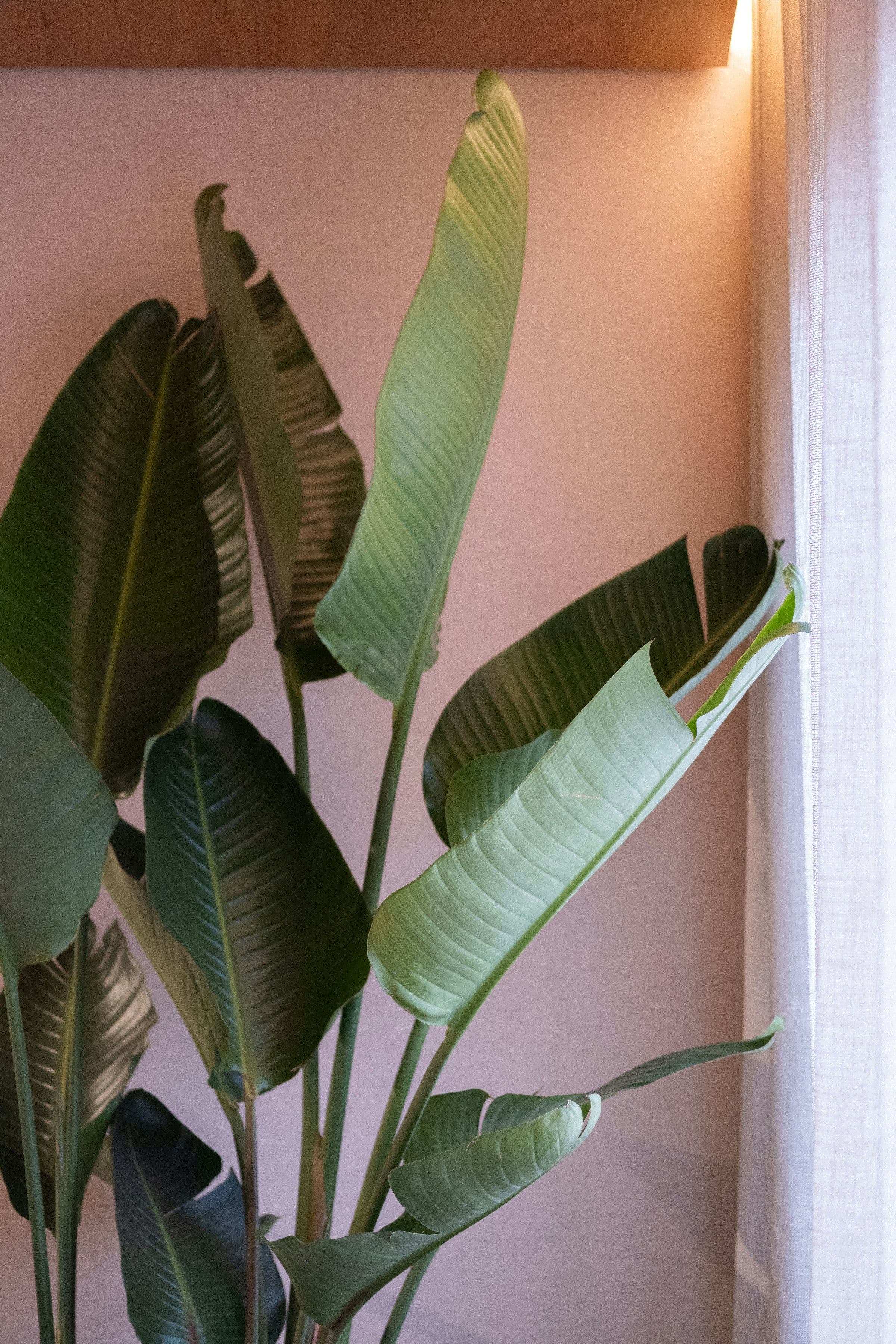
Bird of paradise earns its popularity honestly. Few houseplants create the same immediate architecture: long upright stalks, broad paddle-shaped leaves, and a silhouette that can connect furniture to a tall window or ceiling. The problem is not the look. It is how often the plant is placed as though it were a decorative floor object rather than a large, light-hungry tropical plant.
In most contemporary interiors, the tall green bird of paradise is Strelitzia nicolai, also called white or giant bird of paradise. It can work beautifully beside a substantial sunny window with room for the leaves to open. It is a poor choice for a dim corner, a narrow route, or any spot chosen mainly because it looks empty.
Know which bird of paradise you are buying
The common name covers more than one plant. Strelitzia reginae is the smaller species known for orange-and-blue flowers. The Royal Horticultural Society describes it as reaching at least about five feet tall and more than three feet wide in time. It still needs a large, bright position.
Strelitzia nicolai is the much larger species commonly sold as a dramatic indoor foliage plant. Its mature outdoor scale is tree-like: authoritative profiles place it roughly between 20 and 30 feet tall, with a spread measured in several feet. A container and indoor conditions constrain that growth, but they do not turn it into a permanently compact plant. The long leaf stalks and blades still move outward as well as upward.
Check the botanical label rather than relying on “bird of paradise.” A young S. nicolai may look manageable in the nursery, especially when several stems are grouped in one pot, but the species and the number of growing points reveal more about its future footprint than its current price or pot diameter.
Light is the first placement requirement
The best position is beside a large sunny window or in a conservatory-like room. RHS guidance calls for lots of bright light and places strelitzias next to substantial windows. North Carolina Extension recommends bright indirect light for S. nicolai, while the RHS plant profile specifies full light with protection from the hottest sun under glass.
These descriptions are compatible: give the plant abundant light, then acclimate it carefully to strong direct exposure rather than moving it abruptly from a shaded store into intense afternoon sun. Sheer curtains can soften the hottest window while allowing the plant to remain close to the light source.
A corner does not become suitable because it is beside a pale wall or appears bright to human eyes. If it is several feet from the window, blocked by furniture, or shaded by closed blinds, measure the light or use a properly specified grow light. Weak light produces slower growth, leaning, longer intervals between watering, and little realistic chance of flowering.
Turn the pot periodically so the plant does not lean entirely toward the window. Do not use rotation to justify a dark position; it only distributes the growth response when adequate light already reaches the plant.
Plan for width, height, and movement
An established strelitzia can exceed three feet in width, and S. nicolai may become considerably larger. Measure a generous circle around the pot, not just the nursery container. The leaf stalks arch, new leaves emerge upright, and the blades occupy airspace used by curtains, doors, lamps, and people.
Ceiling height matters because each new leaf rises before it unfurls. So does the route into and out of the room: a large plant that technically fits may be almost impossible to move for cleaning or repotting. Multi-stemmed pots create a fuller look immediately, but they also fill horizontal space faster.
Keep the plant out of a narrow passage and away from a chair that rolls backward. Repeated contact bruises or tears the foliage. It should not cover a radiator, block a supply vent, or sit against cold glass during winter. Allow access to the window, curtains, and the back of the pot without pushing through leaves.
Where bird of paradise actually works
The best room has scale before the plant arrives: a large living room, bright dining area, sunroom, glazed stair landing, or spacious office with a tall window. In these settings, one bird of paradise can connect the lower furniture line to the architecture without needing a group of smaller plants around it.
Place it slightly beside the window rather than directly in the center of the glass. This preserves daylight and views while keeping the leaves close to their source of light. A broad, visually quiet wall gives the silhouette room to register. Leave negative space around the canopy instead of filling the base with baskets, stands, and additional pots.
A simple cylindrical or softly tapered cachepot usually supports the plant better than a highly patterned container. The pot must be stable enough for a top-heavy canopy and should conceal a nursery pot or liner that can drain fully.
Where it is usually misplaced
A dark empty corner is the classic mistake. The plant may survive there temporarily using energy accumulated under nursery conditions, but that does not prove the position is sustainable. Moving it into a hallway, windowless bathroom, or bedroom corner with closed curtains creates the same problem.
It is also misplaced when used to hide an outlet, fill the gap behind a sofa, or soften the end of a dining bench if the leaves must be pushed aside every day. Bird of paradise does not remain a flat vertical screen. Its leaves face the light and extend into the room.
Small apartments do not automatically rule it out, but they leave less margin for error. If the only useful window also serves a desk, radiator, balcony door, or main walkway, a rubber plant or narrow snake plant may provide stronger structure with a more manageable footprint.
Torn leaves are part of the practical decision
The large blades are visually powerful because they expose so much surface. That also makes them vulnerable. North Carolina Extension notes that S. nicolai leaves rip readily in wind, and RHS guidance warns that outdoor summer exposure can shred them. Indoors, passing people, pets, furniture, transport, and an unfurling leaf pressed against a wall can all leave permanent tears or bruises.
One split leaf is not enough to diagnose a sick plant. Look instead for a pattern: widespread browning, distorted new growth, yellowing, pests, or a consistently wet root ball. Scale, spider mites, aphids, and mealybugs are all worth checking for, especially along stalks and the undersides of leaves.
Wipe dust from the blades so they receive as much light as possible. Remove an entire leaf only when it is badly damaged or declining; cutting individual tears into a decorative shape does not restore the leaf.
Water according to season and light
During active spring and summer growth, strelitzias use more water and should not remain completely dry for long periods. The mix should be moist but never saturated, with excess water able to leave the pot. In cooler, darker months, reduce watering and allow more of the mix to dry.
The exact interval depends on window exposure, temperature, pot size, root density, and season. Check the mix rather than following a weekly reminder. A large decorative cachepot can hide standing water, so lift or inspect the nursery pot after every thorough watering.
Use a well-drained, loam-based houseplant mix and move up only one pot size when repotting. A huge container holds unused wet mix around a limited root system and makes an already heavy plant difficult to handle. A broad-based pot or weighty cachepot improves stability, but drainage still matters more than visual mass.
Warmth and humidity support good foliage, while cold drafts and sudden temperature changes do not. Keep the plant above roughly 50–54°F and away from exterior doors that expose it to abrupt winter air.
Do not buy it for guaranteed flowers
The famous orange-and-blue flower belongs to S. reginae. S. nicolai produces a white-and-blue flower, but it becomes an enormous plant and flowering indoors is not dependable. Even S. reginae generally needs maturity, strong light, appropriate feeding, and years of growth before flowering.
Buy S. nicolai for its foliage and scale. If a flower eventually appears, treat it as a result of successful long-term cultivation rather than the expected return from a young nursery plant. A retailer photograph of a flowering outdoor specimen does not describe what will happen in an ordinary living room.
Pet and household safety
North Carolina Extension lists Strelitzia nicolai as toxic to people, dogs, cats, and horses if ingested and notes that contact may irritate skin. Keep the plant beyond the reach of children and animals that chew foliage, and wear gloves if handling it causes irritation.
The common name can also cause confusion with unrelated plants called bird of paradise, including Caesalpinia species. Use the botanical name when checking toxicity or seeking veterinary advice.
Bird of paradise works indoors when the room can support the plant it is becoming, not only the plant that arrives from the store. Give S. nicolai a strong window, a broad footprint, a stable draining pot, and tolerance for some leaf wear. If the available position is dark, narrow, or frequently used, the better design decision is a different plant.