The best narrow indoor plants are snake plant, African spear, Madagascar dragon tree, selected cane-form corn plants, and lucky bamboo grown as a potted plant. Each can create height without beginning as a broad floor-level mass. None, however, fits every narrow space: their leaves still need light, clearance, and room to mature.
A plant is not narrow because it arrives in an eight-inch nursery pot. Measure the widest leaf spread, look at the direction of new growth, and check the likely mature form of the exact species or cultivar. A genuine small-space choice should preserve the path around it after watering, repotting, and several years of growth—not only on the day it is delivered.
Define the space before choosing the plant
Measure the available floor width and depth, then measure the open space higher up. A plant with a slim trunk may still have a three-foot crown. Curtains, doors, drawers, chair backs, and people add movement that a static floor plan does not show.
Mark the usable footprint with painter's tape or paper. Leave a buffer so leaves are not brushed whenever someone passes. In an entry, the plant must stay clear of coats and bags. Beside a window, it cannot prevent the window from opening or block the curtain used every day. In a corner, allow enough access to test the potting mix and remove runoff.
Next, assess daylight at the future leaf height. A narrow gap beside a cabinet may be visually convenient but screened from the window. Do not solve a width problem by placing a plant where it cannot grow. If the only usable position is genuinely dim, plan an appropriate grow light or choose another object for the space.
1. Snake plant: the most dependable vertical footprint
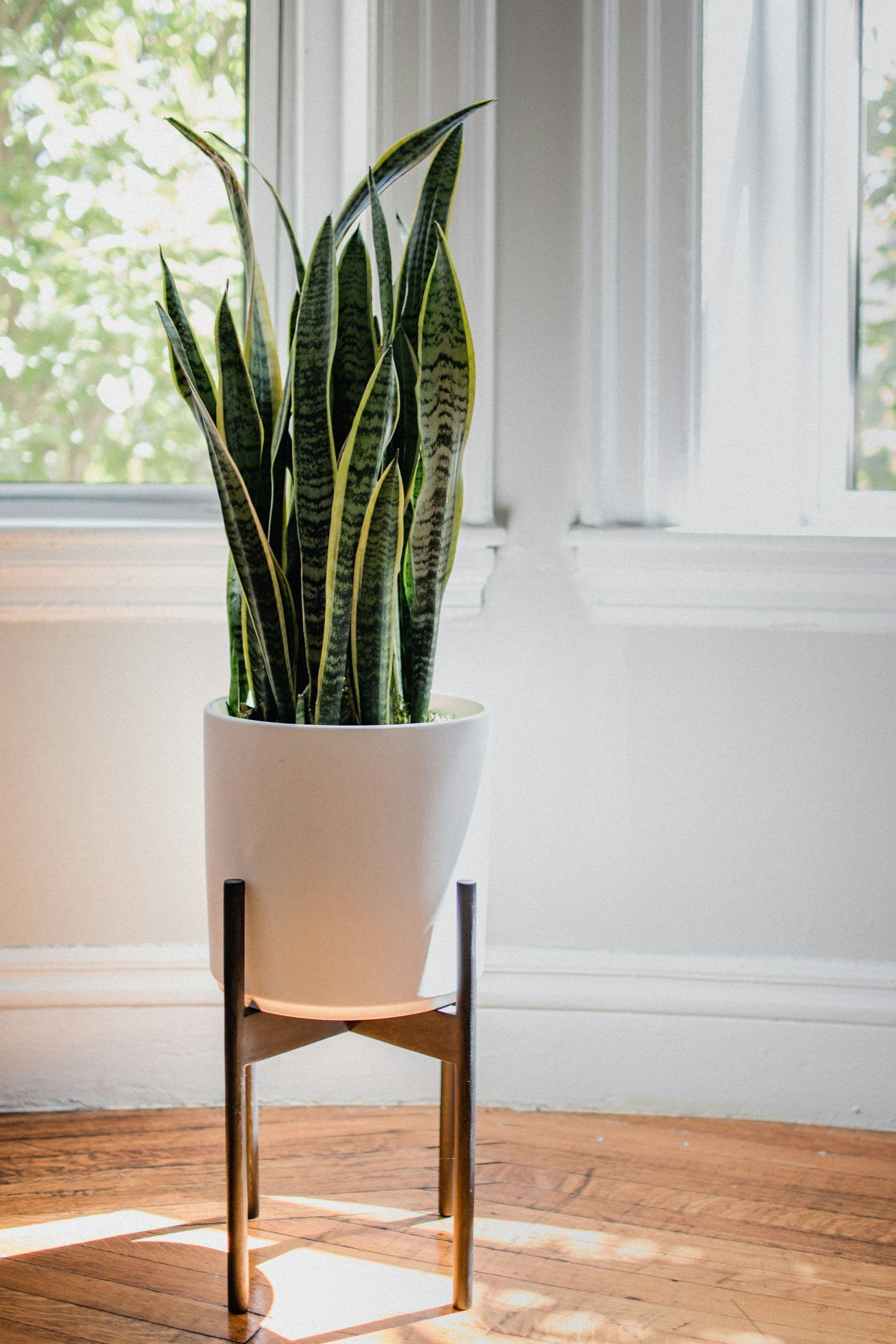
Snake plant, now classified as Dracaena trifasciata and still often sold as Sansevieria trifasciata, has stiff leaves that rise from basal rosettes. North Carolina Extension describes the leaves as upright, up to four feet long, and generally two to four inches wide. That structure gives the plant a clearer vertical outline than most leafy houseplants.
Choose the specimen rather than the name alone. A tall, straight-leaved form creates a different footprint from a low bird's-nest cultivar or a crowded pot with rosettes leaning in several directions. Check the plant from above and allow for new shoots: snake plants are clumping plants and can expand laterally as their rhizomes produce growth.
They tolerate relatively low light but usually hold better growth in useful filtered or partial light. Good drainage and restrained watering matter more than filling the pot on a schedule. A narrow position that is difficult to reach can encourage forgotten runoff or repeated overwatering, so keep the container accessible.
Best use: a compact vertical accent beside a cabinet, at the end of a console, or in a floor area where soft arching leaves would be repeatedly touched.
2. African spear: graphic and even more linear
African spear, Dracaena angolensis, was formerly sold as Sansevieria cylindrica. Its cylindrical leaves rise from a basal rosette and can form a striking fan. North Carolina Extension records a potential container spread from about six inches to two feet, so it is narrow at some sizes but not a permanent bundle of parallel rods.
Look for a naturally growing rosette rather than assuming braided or painted-tip leaf cuttings show the plant's future form. New growth eventually emerges from the base and may widen the silhouette. A small cultivar or young specimen can fit a restricted shelf or floor zone, but the fan needs lateral clearance as it develops.
African spear prefers a brightly lit window and a fast-draining mix. It is drought tolerant, but that does not make a dark windowless recess suitable. Its coarse, sculptural leaves work best against a quiet wall with enough space to read their outline.
Best use: a bright narrow position where a compact, architectural form is more useful than a leafy canopy.
3. Madagascar dragon tree: a slim trunk with an airy crown
Madagascar dragon tree, Dracaena reflexa var. angustifolia, is still widely labeled Dracaena marginata. It develops slender upright stems topped with tufts of very narrow leaves. North Carolina Extension notes that it can reach about six feet as a houseplant and can be pruned smaller.
The trunk can fit a small floor area, but the crown is not a vertical cylinder. Mature leaves can reach about two feet long and arch outward. Buy according to the widest crown, not the pot. A single-cane plant usually reads more lightly than a pot packed with several canes at different heights, although the latter may feel fuller.
Bright indirect light is ideal. The plant may tolerate less, but sparse or weak growth defeats the point of choosing an elegant silhouette. Keep it away from cold drafts and allow the well-draining potting mix to dry appropriately between waterings. Dracaenas can also develop brown leaf tips in response to water quality or other environmental stress.
Best use: a tight floor position that has overhead room and at least modest clearance for an airy fountain of leaves.
4. Corn plant: choose a cane form and cultivar carefully
Corn plant, Dracaena fragrans, is an upright cane-form houseplant with strap-shaped leaves gathered toward the stems. The Royal Horticultural Society describes the species as columnar and upright, but real cultivars vary substantially. North Carolina Extension gives the broader species a possible indoor width of one to three feet and identifies compact cultivars with shorter or denser leaves.
This is a case where the exact plant matters more than the common name. A single cane with a restrained crown can occupy a narrow visual column. Several mass canes planted together, or a cultivar with long strongly arching leaves, may require much more room. Measure the displayed specimen across the leaves and ask for its cultivar name.
Place it in bright to moderate filtered light, protected from intense direct sun. Use a draining pot and do not force a tall plant into a decorative container that makes it top-heavy. A corn plant can become a strong vertical room anchor, but it still needs sufficient width for the leaf rosette.
Best use: a narrow but not razor-thin floor area where a taller, calmer silhouette is wanted.
5. Lucky bamboo: best as a narrow tabletop plant
Lucky bamboo is Dracaena sanderiana, not a true bamboo. It has upright cane-like stems and spaced strap-shaped leaves. The RHS describes it as a slender, erect houseplant and gives many forms a mature spread in the range of roughly four to twenty inches, depending on the plant and cultivar.
It is often sold as a temporary-looking bundle in water. For a more settled interior, choose healthy straight stems in a stable container and treat the roots as a real growing system. North Carolina Extension says it can grow in moist potting mix or chlorine-free water; water-grown arrangements need regular water changes and enough container weight to remain stable.
The leaves eventually extend beyond the canes, so do not buy by stem diameter alone. Give it bright indirect light and avoid a vessel so narrow or tall that it can tip when the top becomes leafy.
Best use: a windowsill, compact desk, or shallow shelf where a small upright plant is needed rather than a floor specimen.
Popular plants that do not stay as narrow as they look
ZZ plant, Zamioculcas zamiifolia, is often shown as an upright solution for small rooms. Its leaves do emerge erect from a central rhizome, but North Carolina Extension gives the species a mature height and width of two to four feet. A young plant may fit a narrow gap; an established specimen can arch well beyond it. Use one only where there is room for that future spread, and give it bright indirect light when possible rather than treating low-light tolerance as a preference.
Ponytail palm, Beaucarnea recurvata, also has a compact-looking swollen base, but its long strappy leaves cascade outward. North Carolina Extension records a mature container width of three to five feet. It can be a good sunny-room specimen, but it is not a reliable answer for a passage only a foot wide.
The same caution applies to parlor palms, umbrella plants, fiddle-leaf figs, and young strelitzias. A narrow trunk does not make a narrow plant. Measure the crown and research the mature indoor form before buying.
Use the pot to support the footprint, not fake it
A tall slim planter can reinforce the vertical line, but the growing pot still needs drainage and enough root space. Do not force a top-heavy plant into a smaller pot to keep the footprint narrow. Choose a stable outer container that fully supports the nursery pot and allows it to be removed for watering.
Keep the planter no wider than necessary, then let the foliage provide the shape. Raising a plant on a narrow stand may bring leaves above furniture, but it also raises the center of gravity. Use a broad stable base, check the stand's load rating at full wet weight, and keep it out of circulation.
One narrow plant usually reads more clearly than several small pots stacked into the same gap. The surrounding negative space is what makes the vertical form visible.
Pet and child safety changes the shortlist
Snake plant, African spear, Madagascar dragon tree, corn plant, lucky bamboo, and ZZ plant are all identified by the cited horticultural sources as harmful or toxic if eaten by cats or dogs. Several can also cause symptoms in people if ingested, and sap may irritate skin. Do not place them in an accessible tight passage simply because the footprint fits.
If a pet chews plants or a young child can reach the display, use a genuinely pet-safer shortlist confirmed under the current botanical name, or leave the position unplanted. Raising a toxic plant on a stand is not reliable protection if the stand can be knocked over. For suspected exposure, contact a veterinarian, physician, or the appropriate poison-control service rather than relying on an article.
The final buying test
Bring the width and depth of the available area to the store. Measure the plant at its widest leaf, confirm the scientific name and cultivar, and compare the likely mature spread with the path around it. Check whether new growth clumps from the base, forms a crown above a stem, or arches outward over time.
Then match the plant to the light. Snake plant and selected dracaenas can tolerate a range of indoor conditions, but tolerance is not permission to place them in darkness. African spear and ponytail palm need especially useful light; a ZZ plant grows best when it is not treated as a windowless-room prop.
The best narrow plant is not the one with the smallest pot. It is the one whose complete outline fits the room, receives enough light, remains stable, and can still be watered without blocking the space. When those conditions align, a slim vertical plant can make a tight room feel more intentional without making it harder to live in.
---