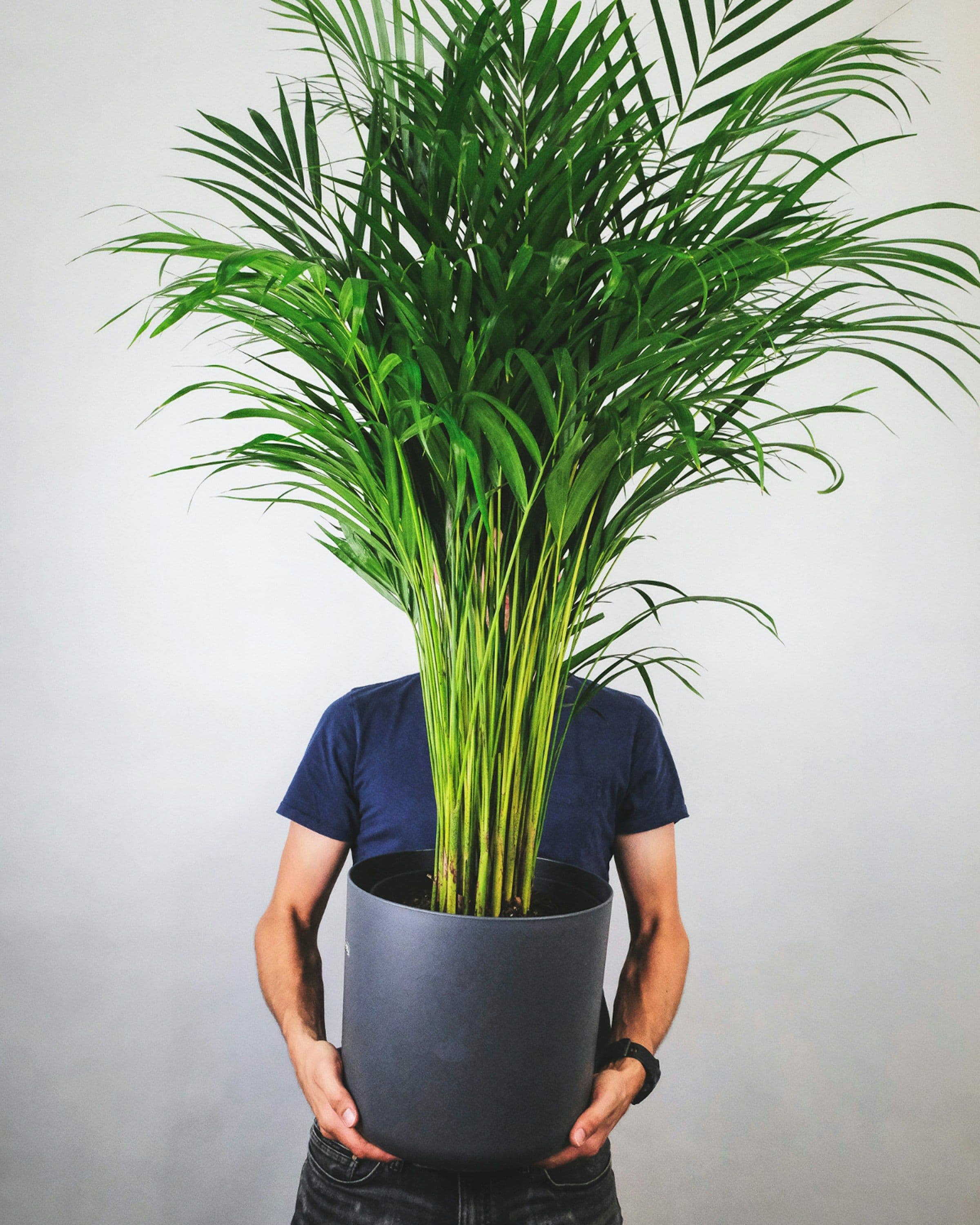
A living room often asks for one substantial plant: a tree-like form beside a sofa, a fountain of foliage near a window, or a broad green shape that gives an empty wall some weight. The familiar recommendations are not always suitable for homes where cats or dogs can reach the floor. Monstera, snake plant, rubber plant, fiddle-leaf fig, and bird of paradise all require caution around pets.
There are better options. Kentia palm, areca palm, money tree, ponytail palm, banana plant, and cast-iron plant are all listed by the ASPCA as non-toxic to cats and dogs. They are not interchangeable, however. Some need direct sun, some occupy several feet of width, and some create presence through a dense outline rather than great height.
What pet-safe means in this guide
“Pet-safe” here means that the ASPCA lists the named species as non-toxic to cats and dogs. It does not mean edible, suitable for repeated chewing, or guaranteed never to cause symptoms. The ASPCA notes that eating any plant material may cause vomiting or gastrointestinal upset.
Check the botanical name on the nursery label before buying. Common names can be dangerously imprecise: sago palm is a cycad, not a true palm, and the ASPCA lists it as toxic to cats and dogs. A label that says only “palm” is not enough evidence for a pet-accessible room.
The potting mix and accessories matter too. Fertilizer, pesticides, sharp supports, decorative stones, and a lightweight pot that can tip are separate risks even when the plant itself is non-toxic. Choose the entire setup for the animal that actually lives there.
1. Kentia palm: the calmest large silhouette
Kentia palm, Howea forsteriana, produces long arching fronds from a relatively clear base. Its outline is open rather than bushy, so it can add height beside low furniture without reading as a solid wall of foliage. The ASPCA lists Kentia, under the common name paradise palm, as non-toxic to cats and dogs.
The Royal Horticultural Society describes Kentia as one of the palms that is comparatively easy to grow indoors and able to tolerate fairly low light. Tolerance is not the same as preference: give it bright indirect light when possible, especially through winter, and keep it away from radiators and cold drafts.
Allow several feet for the fronds to arc. This is a floor plant for a generous window position, not a narrow passage. It is the best choice here when the room needs one elegant, long-lived canopy rather than a dense tropical screen.
2. Areca palm: the fullest green screen
Areca palm, Dypsis lutescens, has many slender stems and a much fuller outline than Kentia. It can soften a broad wall, balance a large sectional, or create privacy near a glazed door. The ASPCA lists it as non-toxic to cats and dogs.
North Carolina Extension recommends a bright indoor position, high humidity, well-drained potting mix, and moisture without sogginess during active growth. This is not the palm for a dim corner. Its broad spread also needs honest measurement: a mature indoor clump can occupy more room than the nursery pot suggests.
The thin leaflets can attract a cat that likes moving foliage. Non-toxic status reduces poisoning risk, but repeated chewing still damages the plant and may upset the animal's stomach. Use Areca when you have bright indirect light and enough open wall or window space for a soft, wide canopy.
3. Money tree: a contained tree-like form
Money tree, Pachira aquatica, is useful when you want the vertical role of an indoor tree without the broad fronds of a palm. Its palmate leaves form small green canopies above visible stems, and commercially grown plants are often sold with braided trunks. The ASPCA lists money tree as non-toxic to cats and dogs.
North Carolina Extension notes that it usually remains around six to eight feet as a houseplant, prefers indirect light or mixed sun and shade, and needs a moist but well-drained mix. Standing water can cause root problems. Indoors, it is grown for the foliage rather than flowers or fruit.
Choose a specimen with a stable trunk structure and enough soil volume to support the canopy. A tight commercial braid can become an issue if ties remain around expanding stems, so remove synthetic ties that are constricting the trunk. Money tree works best as a visually contained anchor beside a cabinet or in a medium-width corner with good light.
4. Ponytail palm: the strongest option for a sunny window
Ponytail palm, Beaucarnea recurvata, is not a true palm. It is a slow-growing, drought-tolerant plant with a swollen water-storing base and a fountain of long, narrow leaves. The ASPCA lists it as non-toxic to cats and dogs.
North Carolina Extension recommends a sunny window, sharply drained soil, deep summer watering followed by drying, and much less water in winter. An established container plant can eventually reach six to eight feet, but growth is slow. The expanding leaf fountain may spread three feet or more even when the trunk remains visually narrow.
This is the most sculptural choice in the list and the best match for a dry, bright living room. It is less suitable where a cat treats the long leaves as a toy or where the only sunny position is a busy route. Give the swollen base a broad, stable pot rather than a tall, lightweight cachepot.
5. Banana plant: the largest leaves and highest light demand
Banana plant, Musa acuminata, offers the broad paddle-shaped leaves people often seek in bird of paradise. The ASPCA lists it as non-toxic to cats and dogs. It is the most visually dramatic option here, and also the least forgiving of an ordinary dim interior.
North Carolina Extension describes the species as fast-growing and naturally very large, with strong light, moisture, regular feeding, warmth, and good drainage among its needs. Container culture restricts its scale, and dwarf cultivars are more realistic indoors, but even a young plant can gain width quickly. The leaves can tear with contact and the plant may produce new shoots from the base.
Choose banana only for a large bright window or sunroom-like living area where humidity, watering, and future growth are manageable. Do not buy it as a direct pet-safe substitute for bird of paradise if the proposed position is still a dark empty corner.
6. Cast-iron plant: a lower, quieter statement
Cast-iron plant, Aspidistra elatior, usually reaches only one to three feet, but its upright, deep green leaves form a dense and grounded mass. It can create more visual weight than a taller plant with a thin canopy. The ASPCA lists it as non-toxic to cats and dogs.
North Carolina Extension describes it as slow-growing, clumping, tolerant of deep shade, and adaptable to well-drained soil that may dry occasionally. That makes it the most useful choice here for a living room with limited indirect light, although no houseplant should be placed in complete darkness.
Use one mature specimen in a broad low pot beside a chair, console, or shaded window. Its leaves occupy the lower zone where pets have easy access, so monitor chewing even though the species is listed as non-toxic. Cast-iron plant is the right answer when the room needs one calm block of foliage rather than height for its own sake.
Choose by light before choosing by shape
The strongest design choice is still constrained by the window. For a sunny position, ponytail palm is the clearest fit, while a banana plant can work when the room is genuinely bright, warm, and spacious. Areca and money tree suit strong indirect light. Kentia is more accommodating but still grows best with useful daylight. Cast-iron plant handles the shadiest position in this group.
Do not place a light-hungry plant several feet into the room because its toxicity profile is convenient. A plant declining in insufficient light is not a successful pet-safe choice. If the living room has no viable daylight at the desired location, change the location, use a properly specified grow light, or choose a nonliving object.
Measure width as well as height. Areca and banana can become broad; ponytail leaves arc outward; Kentia fronds extend into circulation. Money tree is more contained, while cast-iron plant remains lower. Mark the expected footprint on the floor before buying, then keep leaves out of doors, vents, and daily walking routes.
Make the whole plant setup safer
A substantial plant should not be easy to knock over. Use a heavy, broad-based outer planter, keep drainage functional, and protect the floor from overflow. Avoid unstable stands in rooms with active pets. If the plant needs to be raised to escape chewing, wall-mounted placement or a different species may be safer than putting a heavy pot on a narrow pedestal.
Keep fertilizer and pest-control products inaccessible. Do not leave slow-release granules exposed on the surface where an animal can investigate them. Large decorative stones can be swallowed, and loose moss may encourage digging. The simplest safe surface is usually plain potting mix below the rim of a stable pot.
New plants should also be checked for pests and isolated from the existing collection before being introduced. If a pet repeatedly chews even non-toxic plants, manage access rather than treating the behavior as harmless.
Common names are not enough
Retail plant labels are inconsistent, and several unrelated species share names such as palm, money plant, or banana. Match both the common and botanical name to an authoritative toxicity record. For this list, those names are Howea forsteriana, Dypsis lutescens, Pachira aquatica, Beaucarnea recurvata, Musa acuminata, and Aspidistra elatior.
Never infer safety from resemblance. Sago palm, Cycas revoluta, resembles a small palm but contains cycasin and is listed by the ASPCA as toxic to cats and dogs, with potentially severe effects. When the label is vague, do not bring the plant into a pet-accessible room until its identity is confirmed.
If a pet eats a plant
Remove access to the plant and contact your veterinarian or an animal poison-control service if the pet develops symptoms, if the plant identity is uncertain, or if a known toxic plant may have been eaten. Keep the label, take clear photographs, and note which part and approximate amount may be missing. Do not induce vomiting or give a home remedy unless a veterinary professional instructs you to do so.
Pet-safe planting is not about reducing the room to small, forgettable foliage. It is about choosing visual presence from a better starting point. Kentia gives height, Areca gives fullness, money tree gives a contained canopy, ponytail palm gives sculpture, banana gives scale, and cast-iron plant gives weight in lower light. Choose the form only after the light, footprint, and exact botanical identity all work.