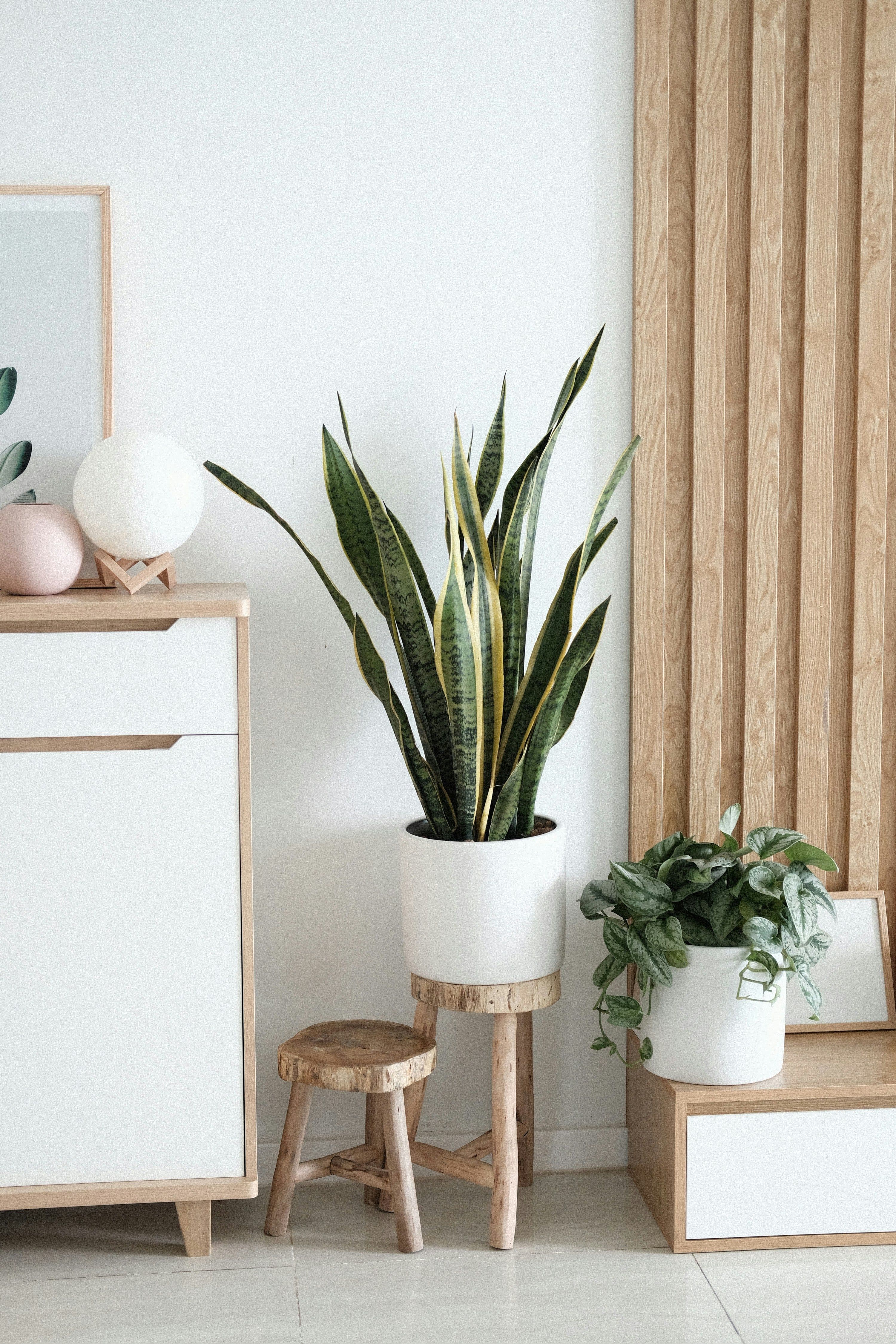
Snake plant is useful because it does something many popular houseplants cannot: it adds height without claiming much horizontal space. The stiff leaves rise directly from the pot instead of branching over furniture, trailing from a shelf, or leaning toward a support. In a room that needs one narrow vertical element, that restraint can be more valuable than lushness.
The plant is not an all-purpose solution, however. Its reputation for surviving neglect has encouraged people to place it in windowless corners, water it on a schedule, and expect the form to remain unchanged. Survival is a poor design standard. A snake plant works best when its light, cultivar, pot, and position are chosen as deliberately as its silhouette.
The direct answer is this: use a tall snake plant where the room needs a narrow, upright accent and receives at least some dependable natural or supplemental light. Choose a dwarf form where the plant must stay on furniture. Avoid placing pointed leaves in circulation paths, and do not interpret drought tolerance as permission to leave the roots wet.
Why the shape is so useful
The accepted botanical name is Dracaena trifasciata, although the older name Sansevieria trifasciata still appears on plant labels and in care guides. The species grows from rhizomes into a clump of erect, succulent leaves. Those leaves are usually banded in several shades of green; common cultivars may add yellow margins, silver tones, or stronger vertical striping.
Visually, the plant behaves more like a compact architectural object than a small indoor tree. It creates a repeated series of vertical lines, with most of its mass held over the footprint of the container. That makes it effective beside a console, at the end of a low cabinet, or in the open strip of floor between furniture and a wall.
This narrow habit is the main reason to choose it over Monstera, rubber plant, or bird of paradise. Those plants may offer larger leaves and more drama, but their stems or petioles spread well beyond the pot. Snake plant gives less volume and movement in exchange for a cleaner, more contained outline.
The best places for a snake plant indoors
A floor-size specimen works well where a room needs height but cannot surrender much width. Consider the end of a sideboard, a bright entry area outside the walking route, or a living-room wall where a broader plant would overlap a chair. Against a plain background, the pointed leaves remain easy to read and do not need a cluster of smaller objects around them.
The plant can also bring structure to a home office. A tall form beside a low storage unit creates a useful change in height without extending over the work surface. A dwarf bird's-nest cultivar such as 'Hahnii' is more suitable on a desk or shelf because its leaves form a short rosette rather than a tall fan.
Do not place a tall snake plant simply because a gap is technically wide enough for its pot. Leaves can lean outward as the clump develops, and their firm tips are unpleasant at face, arm, or leg height. A narrow hallway may be a poor location if people must brush the plant whenever they pass. The same plant can work a few feet away in a recessed entry or at the protected end of a cabinet.
Low-light tolerant does not mean no light
Snake plant tolerates a broad range of indoor light and is legitimately more adaptable than many statement plants. University guidance includes it among low-light houseplants, while botanical and extension sources also describe brighter or partially shaded positions as preferable. These statements are not contradictory: the plant can persist in weaker light, but useful growth still depends on light.
In a dim position, new growth may be slow and the difference between the plant's lighter and darker markings may become less pronounced. Variegated forms with yellow or pale areas have less green tissue available for photosynthesis and are usually better placed in brighter indirect light. Strong, abrupt afternoon sun can scorch foliage that has been grown under softer conditions, so a major increase in exposure should be gradual.
Judge the actual position rather than the room label. A "bright living room" can still contain a dark wall far from its windows. If the location receives almost no daylight, add an appropriate grow light or choose a nonliving object. A plant that merely declines slowly is not succeeding.
Water for the roots, not the reputation
Snake plant stores water in its fleshy leaves and tolerates dry periods, but it is vulnerable to continually wet potting mix. Let the mix dry between waterings, then water thoroughly and allow the excess to drain. Do not leave the nursery pot standing in water inside a decorative cachepot.
A fixed weekly schedule is especially risky. Drying time changes with light, temperature, season, container material, pot size, and the amount of active root growth. A plant in brighter summer light may use water considerably faster than one in a cool, dim winter room. Check the mix below the surface and the weight of the pot instead of watering because a calendar alert appears.
Use a free-draining mix and a container with a drainage hole. Taller plants can become top-heavy, so stability matters as much as appearance. A broad-based ceramic or terracotta cachepot can visually ground the leaves, but any water collected inside it should be emptied. Repot only when the clump has filled the container or made it unstable; an unnecessarily large pot surrounds the roots with more wet mix than they can use.
Choose the form before choosing the pot
The standard green form has horizontal banding and a relatively quiet appearance. 'Laurentii', with yellow leaf margins, creates a stronger color contrast and can suit a room that already uses warm wood, brass, ocher, or muted yellow.
'Moonshine' has broader, silvery leaves and a cooler, more uniform presence. It can work well with stone, brushed metal, pale oak, and cool off-whites, but its lighter foliage needs enough light to retain its character. 'Bantel's Sensation' has narrower leaves with pale vertical striping, producing a finer and more graphic pattern. Compact 'Hahnii' forms belong on tables and shelves rather than being treated as miniature floor plants.
Match the pot to the selected form. A tall clump often looks most convincing in a simple container with enough visual weight to support it. Very narrow, elevated stands can exaggerate the plant's top-heavy quality. Dwarf rosettes can tolerate a lower, wider pot, provided it has drainage and does not leave a small root system surrounded by excessive soil.
Styling it without making the room feel generic
Avoid combining a yellow-edged cultivar, a highly patterned pot, and several small decorative objects in the same narrow zone. The leaf banding already provides pattern. A restrained planter and a quiet background let the outline do the work. If the room contains many straight lines, use the plant as a concentrated vertical accent rather than repeating it in every corner.
One substantial clump usually has more presence than several undersized pots distributed around the room. Repetition can be effective in a large commercial space, but in a home it can quickly resemble generic staging. Give the plant a specific job: mark the end of furniture, add height beside a low object, or occupy a protected narrow footprint.
Practical drawbacks before you buy
The leaves do not recover from creases, cuts, or damaged tips. Continual contact with chairs, doors, bags, or people can leave a supposedly clean architectural plant looking worn. Dust also shows on broad or dark cultivars, so wipe leaves gently with a damp cloth and inspect for mealybugs or spider mites while doing so.
Snake plant is toxic to cats and dogs if eaten. The ASPCA identifies saponins as the toxic principle and lists nausea, vomiting, and diarrhea among likely signs. A floor plant is not meaningfully "out of reach" for an animal that chews foliage, so choose a pet-safe alternative if access cannot be controlled.
Snake plant earns its place when the room needs a narrow vertical shape and the position can support a living plant. Give it usable light, a stable draining pot, space away from traffic, and a cultivar whose color belongs in the room. In those conditions, its familiarity becomes a strength: a clear, durable form doing one job well.