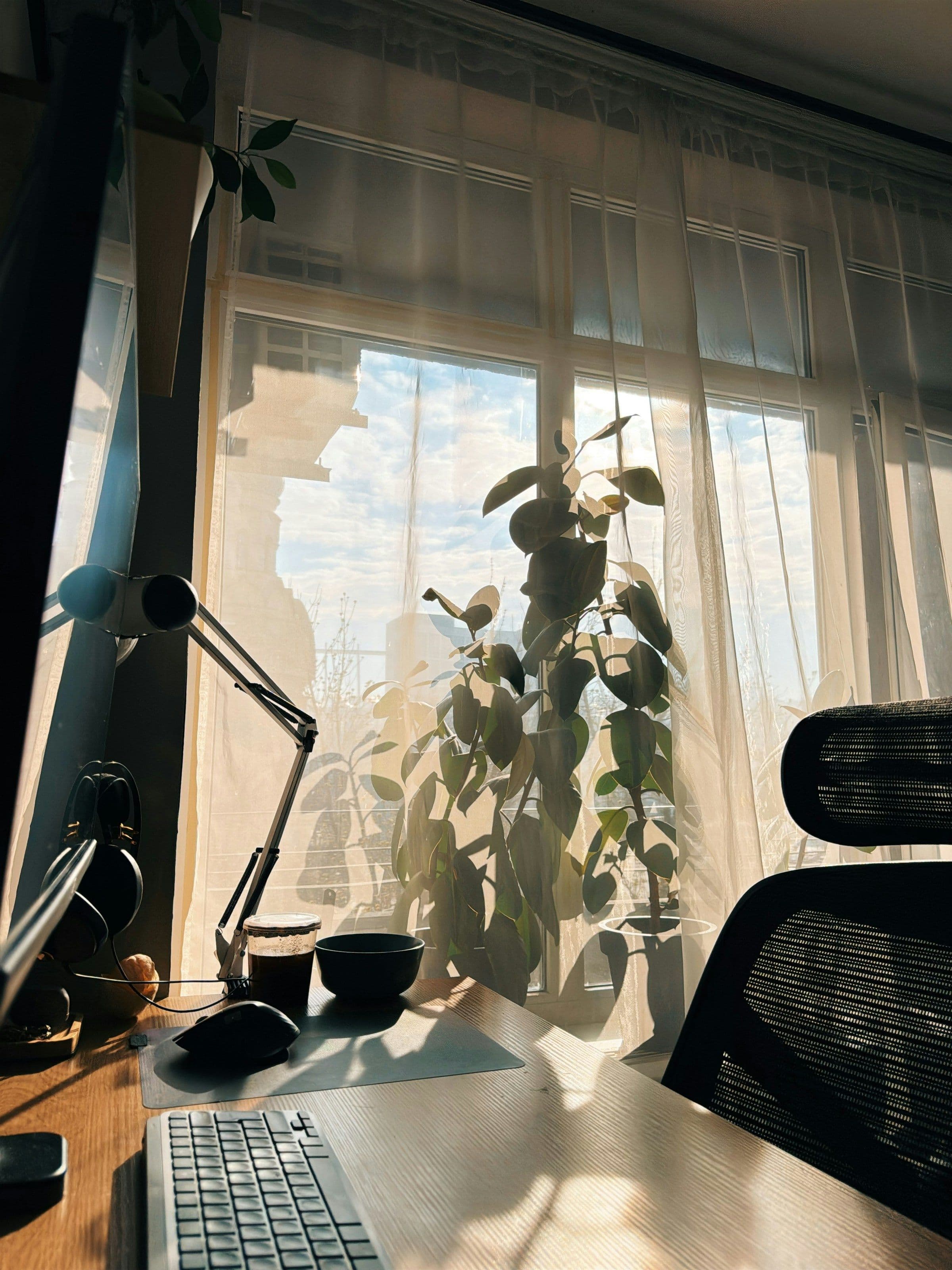
The best plant for a home office is not necessarily the smallest succulent beside a laptop or the largest tree that fits behind a chair. It is the plant whose light and watering needs match the room, whose mature shape stays clear of the work area, and whose care does not create a recurring problem around electronics and cables.
Five plants cover the most useful roles: baby rubber plant for a desk or shelf, snake plant for a narrow floor position, ZZ plant for glossy structure in lower light, cast-iron plant for a quiet pet-safer floor option, and ponytail palm for a sunny office. Choose the role first, then the species.
Start with the light at the plant's position
A home office often feels bright because the screen, task lamp, and ceiling lights are on for much of the day. Plants do not interpret ordinary room brightness as we do. They need sufficient light for photosynthesis, whether it comes from a window or a horticultural grow light.
Observe the intended plant position rather than the room as a whole. A desk beside an unobstructed window may offer useful light, while a bookcase on the opposite wall receives far less. Blinds kept closed to control screen glare can change a seemingly bright office into a low-light plant position.
University of Minnesota Extension recommends matching a plant to the actual light environment and notes that supplemental lighting can compensate when natural light is insufficient. Snake plant and ZZ plant tolerate lower light, but tolerance does not mean darkness. In weak light, growth slows and the potting mix remains wet longer.
If the office has no useful window, choose a properly specified grow light on a consistent timer. A decorative desk lamp is not automatically a plant light, even when it is used for long workdays.
Decide whether the plant belongs on the desk or the floor
A desk plant should not occupy the area needed for a keyboard, notebook, document, or forearm. It should also be simple to lift away from electronics for watering. A compact plant on a side return, deep windowsill, or nearby cabinet usually works better than one squeezed between the monitor and a coffee cup.
Floor plants need a different test. Roll the chair backward, open the door, reach the outlets, and use any filing drawers before deciding where the pot can remain. Leaves that repeatedly catch on clothing or chair arms will become damaged and irritating. A decorative container should sit on a stable, waterproof surface, not directly over cables or a power strip.
For a video-call background, one legible plant form is calmer than a shelf filled with small pots. A snake plant, ZZ plant, or cast-iron plant can give the frame depth without turning the room into a botanical display.
1. Baby rubber plant: the strongest desktop choice
Baby rubber plant, Peperomia obtusifolia, has thick rounded leaves and a contained, bushy habit. North Carolina Extension specifically identifies it as a desktop plant and notes that it usually remains under two feet. A small green cultivar can sit on a shelf, side return, or wide desk corner without trailing across papers or cables.
It prefers bright indirect light, though plain green forms can tolerate lower light for a period. Direct sun can burn the leaves, while wet soil, extreme dryness, and drafts can cause problems. Use a small pot with drainage and let the mix dry appropriately before watering; an oversized cachepot makes it easier to leave excess water around the roots.
The ASPCA lists Peperomia obtusifolia as non-toxic to cats and dogs. It is the best first choice when pet access, surface area, and a restrained shape all matter.
2. Snake plant: narrow structure beside the desk
Snake plant, Dracaena trifasciata, is useful when the office needs height but has little spare width. Its upright leaves can fit beside a low cabinet or in a protected corner where a palm or trailing plant would spread into the room.
It tolerates lower light but grows better with useful indirect light. Allow the potting mix to dry between waterings and use a container that drains. The most common office mistake is treating its reputation for toughness as permission to water on schedule in a dim position.
Keep the pointed leaves out of the path between the chair and door. Snake plant is toxic to cats and dogs if eaten, so use a pet-safer option where chewing is likely.
3. ZZ plant: glossy form for a cabinet or floor position
ZZ plant, Zamioculcas zamiifolia, offers a softer rhythm than snake plant while remaining visually organized. Its arching stems of glossy leaflets work on a low cabinet when young or as a floor plant once the pot becomes substantial.
It can grow in very low light and under fluorescent lighting, according to North Carolina Extension, but it performs best in bright indirect light. Strong direct sun can scorch the foliage. Its rhizomes store water, so the potting mix should dry and the roots should never stand in water.
Do not assume a ZZ plant will remain narrow. An established specimen may reach roughly two to four feet in height and width. It is also toxic to cats and dogs and should be positioned accordingly.
4. Cast-iron plant: a pet-safer choice for a quiet corner
Cast-iron plant, Aspidistra elatior, produces individual dark leaves from the base, forming a slow, upright clump. It is less glossy and graphic than a ZZ plant, which can be an advantage in an office already filled with screens, shelving, and equipment.
It tolerates shade, avoids the direct sun that can bleach its foliage, and grows slowly. A mature clump can reach approximately one to three feet in height and width, so give it a real floor position rather than pushing it against a rolling chair.
The ASPCA lists cast-iron plant as non-toxic to cats and dogs. Choose it when the office has lower indirect light, a pet can reach the floor, and the room would benefit from one broad-leaved but visually quiet plant.
5. Ponytail palm: sculptural form for a sunny window
Ponytail palm, Beaucarnea recurvata, is the bright-office option. It has a swollen water-storing base and a fountain of narrow curling leaves. A young plant can make a sculptural accent on a cabinet, but its care and long-term size are very different from those of a shade-tolerant desk plant.
Give it a sunny window, sharply drained potting mix, and time to dry between deep waterings. It is slow growing and drought tolerant, yet a container-grown plant can eventually reach six to eight feet with a spread of several feet. The leaves can also extend into circulation well before the trunk becomes tall.
The ASPCA lists ponytail palm as non-toxic to cats and dogs. Use it where bright light is available and where its expanding leaf fountain will not interfere with blinds, a monitor, or the chair.
Keep watering away from electronics
Never water a plant in place above a keyboard, power strip, printer, or computer tower. Lift a tabletop plant to a sink, water thoroughly, allow it to drain, and return it only after the outside of the pot is dry. For a larger floor plant, use a waterproof saucer or cachepot system that can be inspected and emptied.
Decorative stones at the bottom of a closed pot do not create drainage. A nursery pot placed inside a decorative container is practical only when it can be removed easily and the outer container does not hide standing water.
Office conditions also change. Heating, air conditioning, closed blinds, and seasonal sunlight alter how quickly the potting mix dries. Check the plant and mix rather than repeating a calendar reminder indefinitely. Dust leaves periodically and inspect for scale, mites, or mealybugs before a small problem spreads to other rooms.
One or two plants are usually enough
A home office needs concentration space, storage, and easy movement. It does not need a plant on every shelf. Begin with one clear decision: a compact desktop peperomia, a structured floor plant, or a ponytail palm at a sunny window. Add a second only if it serves a different visual role and the room still functions comfortably.
Repeat container materials rather than plant quantities. Two pots in related matte ceramic or restrained metal can connect different parts of the room without appearing as a collection. Keep trailing stems away from shelves used for files and avoid planters that compete with already visible cables and equipment.
Do not choose a home-office plant because a list promises higher productivity or purified air. Research on plants and well-being may support enjoying greenery, but it does not guarantee that one pot will improve focus or work output. Ordinary numbers of houseplants also do not replace ventilation or filtration.
The strongest office plant is simply one that fits the light, keeps the work surface usable, and remains easy to care for. That may be a single peperomia beside a window or one deliberate floor plant behind the desk. The room will feel more resolved when the plant has a clear job and enough space around it.