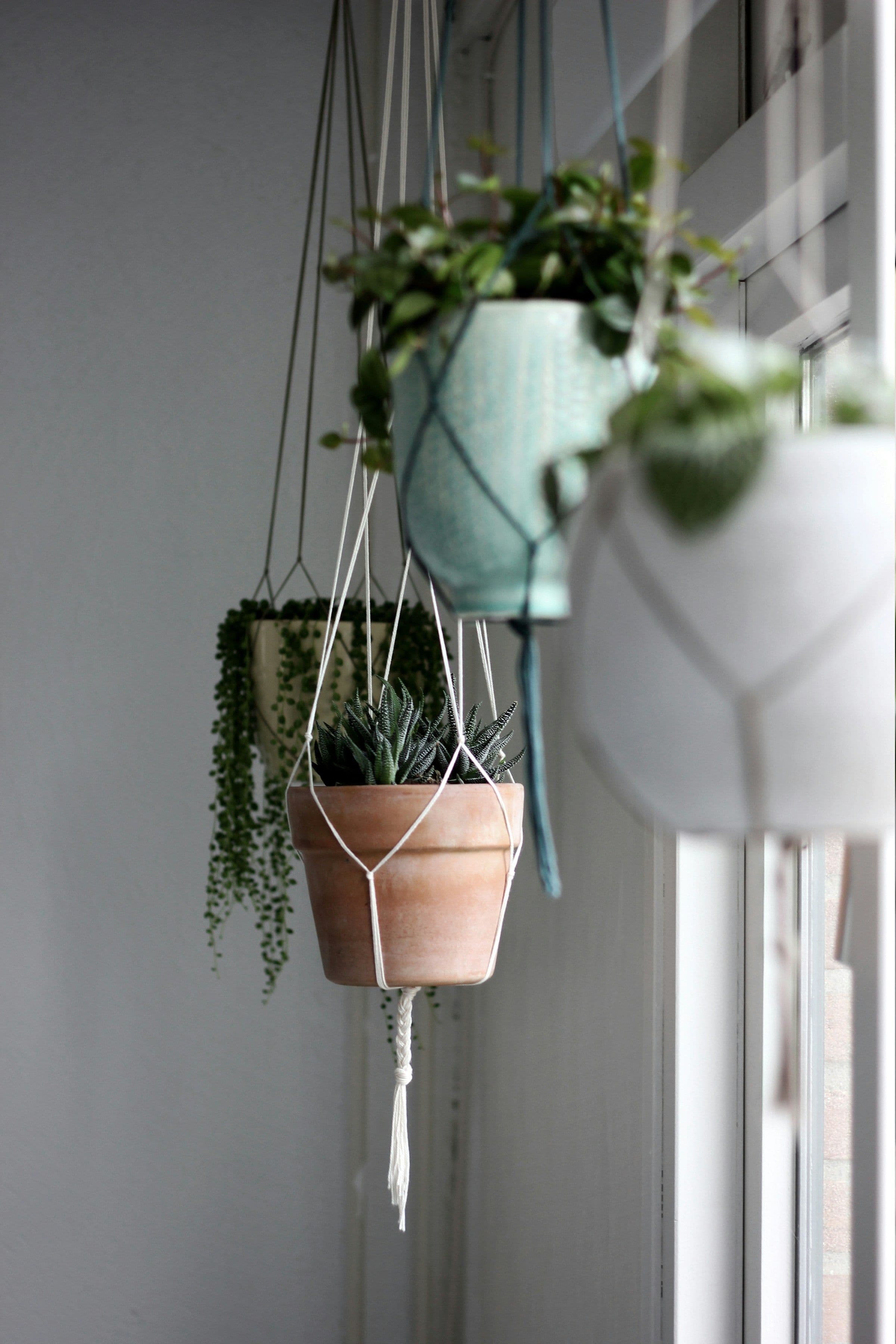
The most dependable way to hang a plant without drilling is to make the support rise from the floor. A purpose-built freestanding plant hanger or a floor-to-ceiling tension pole keeps the load off an unknown adhesive bond. A rated clamp can work on suitable furniture, and an existing rail or hook may work when its intended load is verified. Adhesive ceiling hooks are usually better reserved for very light, nonvaluable decorations or air plants—not a soil-filled pot.
Every method must be judged by the complete watered assembly: plant, wet potting mix, inner pot, decorative container, saucer or reservoir, hanger, and any water left inside. If the support fails, the question is not whether the wall remains unmarked. It is what the pot can hit on the way down.
Start with the wet weight, not the nursery label
A hanging plant becomes substantially heavier after watering. The reliable number is not the empty planter's product weight or the small plastic pot at the store. It is the greatest weight the installed support will actually carry.
Place the complete assembly on a household scale after watering and allowing the normal drainage period. Include the hanger and every decorative layer. If the plant will be watered in place, include the maximum water that a reservoir or cachepot could retain. Repeat the check after repotting, because a larger pot and more mix change the load.
Do not distribute an overweight pot across several adhesive hooks unless the manufacturer explicitly approves that arrangement. The load will not necessarily divide evenly, and one hook can peel first. Product ratings also apply only to the stated surface, orientation, preparation, temperature, and installation method. A wall rating cannot be assumed to apply overhead.
Build in a conservative margin rather than selecting a support whose published limit exactly matches today's scale reading. Plants grow, wet mix varies, hardware wears, and a pot can swing during watering or cleaning. If the maker does not publish a relevant rating for the installed configuration, the system is not a verified plant support.
1. Use a purpose-built freestanding hanger
A floor-supported plant hanger is the strongest default because its stability can be seen and tested without relying on paint, plaster, or a ceiling finish. Look for a broad base, a low center of gravity, a stated total load, and hooks specifically intended for suspended planters. Confirm whether the rating applies per hook, per arm, or to the entire frame.
Do not assume that a garment rack or decorative ladder is suitable because it has a horizontal bar. A load hanging forward can tip a narrow frame even when the bar itself does not bend. Use furniture only for its designed purpose, keep the heaviest pot nearest the center, and test the arrangement at floor level before raising anything.
Place the frame outside the circulation path and away from doors, pets, and curtains that can catch the foliage. If the product requires wall anchoring for stability, it is not a no-drill solution when used without that anchor. The U.S. Consumer Product Safety Commission advises securing top-heavy furniture and following the manufacturer's instructions; removing the prescribed restraint changes the safety of the product.
The visual advantage is control. One slim frame can hold two plants at different heights and read as a single object, while remaining movable enough to follow seasonal light. Leave open space between the trails instead of filling every available hook.
2. Consider a purpose-built floor-to-ceiling tension pole
A tension plant pole transfers force between the floor and ceiling without a screw, which can give a true hanging effect in a small footprint. It is suitable only when the manufacturer approves the ceiling type, floor finish, room height, load, and vertical installation shown in your home.
Measure the span precisely and inspect both contact surfaces. Sloped, fragile, loose, heavily textured, or damp ceilings may be incompatible. A rug or compressible mat beneath the lower foot can let tension change. Follow the exact assembly sequence and recheck the pole after loading, after watering, and periodically thereafter.
Keep all pots within the stated combined capacity and balance their positions around the pole. Do not add a longer arm, improvised crossbar, or heavier ceramic planter than the system was designed to carry. Place it where a slip would not send a pot toward a bed, seat, desk, crib, aquarium, television, or frequently used path.
Tension hardware can reduce holes; it cannot make an unsuitable surface sound. If the ceiling flexes, the pole drifts, or the instructions are missing, choose a freestanding frame or an elevated shelf instead.
3. Use a rated clamp only on suitable furniture
Clamp-on planter arms and hooks can create height from a sturdy table, fixed counter, deep shelf, or substantial windowsill. The product must specify the permitted support thickness, edge shape, material, orientation, and load. A clamp made for a lamp is not automatically rated for a wet plant.
Inspect the furniture as carefully as the clamp. Thin veneer, glass, a hollow shelf, a rounded edge, or an unsupported overhang can crush, crack, or flex. Protect the finish only with pads supplied or approved for the clamp; adding a soft improvised layer can reduce grip. Tighten according to the instructions and check it again after the first few days.
Keep the pot close to the supporting edge rather than extending a long arm into the room. The farther the load sits from the clamp, the more leverage it creates. Do not clamp to a movable tray table, a shelf that can tip, or a window component needed for opening, locking, blinds, or emergency escape.
A clamp is most convincing with one small lightweight planter. Trying to build a canopy from several add-on arms creates more hardware and more uncertainty than one well-designed floor system.
4. Reuse existing hardware only after verifying it
An apartment may already have a picture rail, ceiling hook, exposed beam fitting, plant rail, or fixed bracket. Existing does not mean structural. It may have been installed for a light pendant, curtain, picture wire, or decoration, and its fastener can be hidden behind the finish.
Ask the owner or building manager what the fitting is intended to hold and whether plants are permitted. Inspect for movement, corrosion, cracks, stains, or a loose ceiling surface. If no reliable rating or installation information exists, do not test the hardware with a pot over occupied space.
Ordinary curtain rods, shower rods, pipes, sprinkler lines, and light fixtures are not plant rails. Their apparent strength says nothing about the brackets, seals, or surrounding material. Never attach a plant to building services or anything required for fire protection, ventilation, plumbing, or electrical use.
When an existing feature is genuinely approved and rated, use a closed hanger that cannot hop off the support and a lightweight pot that can be removed without pulling sideways. Keep the installation visible enough to inspect.
5. Treat adhesive hooks as a very limited option
Adhesive hooks vary by product. The current rating and instructions on the exact package matter; similar-looking hooks can have different capacities and approved surfaces. 3M's product catalog lists a range of weight limits, while its ceiling-hook instructions warn against textured ceilings and hanging items over beds or using the product for valuable or irreplaceable objects.
Those warnings matter for plants. A tiny pot may already exceed a lightweight ceiling hook's intended use when the mix is saturated. Humidity, dust, fresh paint, wallpaper, heat, surface texture, and incorrect preparation can compromise adhesion or damage the finish.
Do not use an ordinary wall hook overhead, rotate a strip into an orientation the maker does not approve, or infer that several strips multiply the rating. If a specific ceiling product explicitly allows the surface and full wet weight, follow every preparation and waiting step and still keep the object away from people and valuables.
The better use for a lightweight adhesive hook is often to guide a vine across a wall while its pot remains safely supported on a shelf. Leave slack for growth and use clips that do not pinch the stem. For a truly suspended but very light display, air plants avoid wet potting mix; the RHS describes hanging air-plant arrangements that are removed for soaking and allowed to drain before rehanging.
6. Create the effect of hanging without suspension
A plant does not have to hang from the ceiling to create a descending line. Place a trailing plant on a tall, stable cabinet, a deep shelf, or a floor-standing pedestal so the foliage falls through open wall space. This often provides the visual result with fewer failure points and easier watering.
The furniture must still be stable, suitable for the wet load, and protected from water. Keep the pot far enough from the edge that a tug on the vine cannot pull it down. In homes with children or climbing pets, a tall freestanding unit may require anchoring; if anchoring is not allowed, use a lower and broader support instead.
This option is especially useful when the ceiling is textured, the lease prohibits attachments, or no product is rated for the full assembly. It also makes the plant easier to rotate, prune, and inspect for pests.
Plan the light and watering before the hardware
A hanging point near the center of a room may be visually appealing but too dim for sustained growth. University of Minnesota Extension emphasizes matching houseplants to the existing light at the exact position. Measure from the window to the leaves, not to the nearest wall, and remember that a plant mounted above the window can sit in its own shadow.
Keep blinds, curtains, and operable windows working normally. Leaves should not rub against hot glass or become trapped in a door. Do not block a required exit or place a pot where someone must duck beneath it.
Watering must be possible without balancing a full can overhead. When practical, lift the inner pot down, water it over a sink or tub, let it drain, and return it to the hanger. Penn State Extension recommends drainage and removal of excess water from cachepots. A sealed decorative pot can still overflow or conceal standing water.
The RHS notes that hanging baskets can dry faster than other containers and that added potting material increases weight. Check moisture rather than following a fixed schedule. Use a lightweight draining inner pot, a secure hanger, and a washable outer container or tray only when the system is designed to hold it.
If access requires a ladder or step stool, use equipment of the correct height on a level surface and follow its labels. OSHA's portable-ladder guidance—written for workplaces but sensible at home—includes inspecting the ladder, facing it, maintaining three points of contact while climbing, and not exceeding its load rating. If routine watering requires leaning sideways with a heavy pot, the display is too high or too difficult to maintain safely.
A final no-drill decision check
Before installing anything, confirm the lease or property rules, the support's intended use, the approved surface, the full wet weight, and the consequence of failure. Make sure the plant receives useful light, can be watered without an awkward reach, and will not swing into glass, furniture, people, or pets.
Choose a floor-supported hanger first, a purpose-built tension pole second, and a correctly rated clamp only for a small controlled load. Use verified existing hardware when permission and installation details are clear. Reserve adhesive support for loads the exact product explicitly permits, and reject improvised curtain rods, suction cups, pipes, and unverified hooks.
This is general design and safety information, not a substitute for the product instructions, building rules, or advice from a qualified installer. No-drill display is a constraint, not a guarantee. The best solution is the one that remains stable when the plant is wet, growing, and being cared for—not merely the one that leaves no visible hole on installation day.